

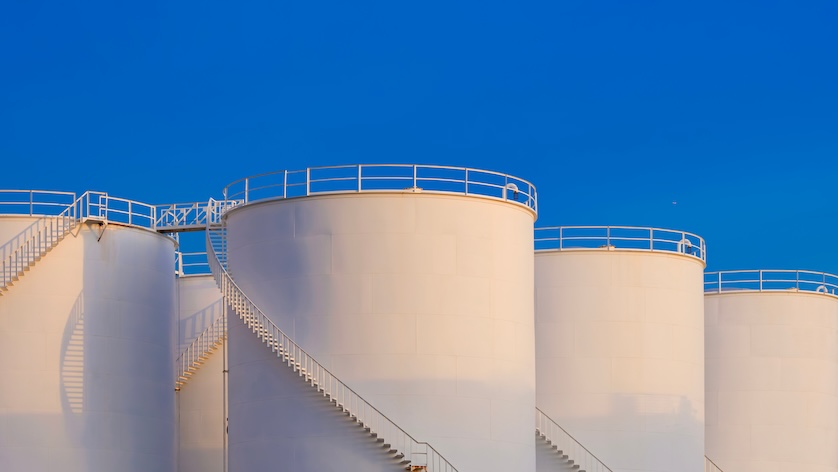
Upstream production sites rely on enclosed vessels to temporarily hold crude oil, produced water, and gas condensate after phase separation. WIKA offers a variety of instruments for measuring and controlling level in production storage tanks.
The effluent that’s pumped or lifted from a well contains oil, natural gas, water, and occasionally solids like sand and shale. After separators and treaters isolate the various phases and components, the remaining liquids are stored briefly in a battery of tanks to stabilize flow between continuously producing wells and periodic pipeline or trucking transportation.
Types of Production Storage Tanks
Storage tanks are either vented to the atmosphere or pressurized, depending on the fluid’s volatility. Design choices are influenced by the type of liquids stored, required capacity, operating pressure, and the specific goal of reducing volatile organic compound (VOC) emissions.
Fixed roof tanks
The majority of production tanks have a flat or domed roof that does not move. These enclosed vessels are used to store liquids, like oil or produced water, with pressures at or near ambient pressure. Such fixed roof designs cannot hold significant pressure or vacuum and so are either freely vented or equipped with a pressure/vacuum vent.
Floating roof tanks
To prevent the release of volatile organic compounds (VOCs), floating roof tanks are used to hold crude oil and natural gas liquids (NGLs). These roofs float on the liquid’s surface, significantly reducing the vapor space above the stored liquid, thereby decreasing evaporation and VOC emissions compared to fixed roof tanks. Floating roof tanks are crucial for environmental compliance, as VOCs are regulated due to their role in forming smog and other harmful pollutants.
There are two main types of floating roof tanks:
- External floating roof (EFR) tanks have an open-topped shell with a deck that floats directly on the liquid. They are effective but are susceptible to wind, which can increase vapor loss.
- Internal floating roof (IFR) tanks have a floating roof within a fixed roof tank, creating a dome. This design offers superior protection against wind, reduces emissions more effectively, and helps insulate the liquid from temperature fluctuations.
Level Measurement in Production Storage Tanks
Oil & gas producers use a variety of level instruments to monitor and control fluids in production tanks. There are many variables to consider when selecting the appropriate level instrument.
Fluid characteristics and process conditions
- Pressure: The tank’s internal pressure or vacuum conditions are crucial for sensor selection, especially in sealed tanks with vapor pressure in the head space.
- Temperature: The process and ambient temperatures must be within the sensor’s operating range to ensure accuracy and longevity.
- Chemical compatibility: The liquid’s chemical nature, including corrosiveness, affects the choice of sensor materials and technology.
- The fluid’s density (specific gravity): This is essential for converting pressure measurements to level for certain sensing methods, such as hydrostatic level measurement.
Tank and installation
- Tank shape and size: The geometry of the tank influences how the level measurement is performed.
- Vessel connections: Check if the tank already has suitable fittings or if new ones are required.
- Environmental factors: Consider conditions like foam, steam, conductivity, or the presence of gases that could interfere with the level measurement.
Measurement requirements
- Accuracy: The required level of precision will help narrow down sensor choices.
- Output signal: Decide on the desired output, such as 4…20mA, 0…10V DC, or another signal for integration into a control system.
- Continuous vs. point level measurement: Determine if you need to monitor the level continuously, such as by using a submersible pressure sensor, or if you only need to detect high/low points using switches.
Liquid Level Monitoring Instruments for Tanks and Vessels
WIKA offers a wide range of smart measurement solutions for all types of oil field production tanks.

Level measurement in production tanks: instruments and where to mount them

LS-1000 and LF-1 submersible pressure sensors (for level measurement), WIKA LevelGuard
The LS-1000 submersible pressure sensor is designed for continuous level measurement up to 33 ft (10m). It offers standard output signals of 4…20mA or an optional low-power output signal of 0.5…4.5V DC ratiometric suitable for battery operation. The housing is made from welded 316L stainless steel with IP68 ingress protection, and the cable includes integrated fiber mesh for strain relief. The LS-1000 sensor requires no regular maintenance, has an accuracy of ±0.5% of span, and is available with international approvals for use in hazardous areas.
The LF-1 submersible pressure sensor is designed for continuous level measurement up to 200 ft (61m). It offers output signals of 4…20mA, 4…20mA + HART®, or a 0.1…2.5V DC low-power option. This level transmitter is built for long-term use with various liquids, including crude oils, and the intrinsically safe electronic system meets international safety standards for environments with explosive gases and vapors. Equipped with specially developed cables, components made from high-alloyed stainless steel, and optional overvoltage protection against lightning, the LF-1 is suitable for outdoor measurement applications.
The WIKA LevelGuard™ anti-clog attachment for submersible transmitters is built for challenging level sensing environments with sludge, slurry, or turbulence. Its large two-inch diaphragm ensures high sensitivity and reliable performance, even at low liquid levels or when buried in sludge. The cable can withstand over 200 lb. of strain, removing the need for extra support or conduit connections.
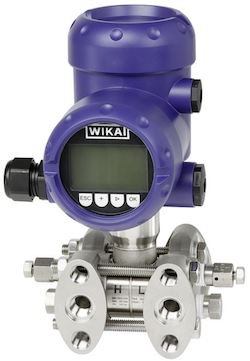
DPT-20 DP transmitter
The DPT-20 differential pressure transmitter is precise, durable, and flexible, making it an ideal choice for continuous level monitoring. Designed to measure the hydrostatic pressure difference between the bottom of a tank and a reference point – either atmospheric pressure (for open tanks) or vapor space pressure (for closed tanks) – the DPT-20 converts this differential into a level reading, factoring in the fluid’s specific gravity for accurate results. It is suitable for both low- and high-pressure environments, supporting ranges from −0.15 to 240 psi, with a static pressure tolerance up to 5,800 psi. The many output signals include 4…20mA, HART®, FOUNDATION™ Fieldbus, and PROFIBUS® PA. Options for intrinsically safe or flameproof enclosures are also available. When paired with a diaphragm seal, the DPT-20 can handle extreme temperatures as well as corrosive, abrasive, viscous, or toxic media. This level sensor is easy to configure onsite with an optional display module, which has an intuitive menu and can be mounted in four different orientations. It can also be configured remotely via PACTware™ software and Device Type Manager (DTM).
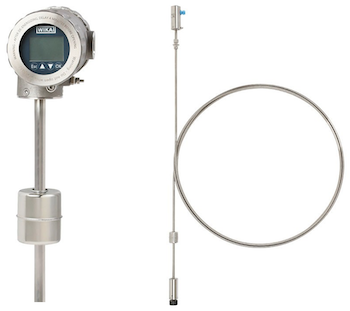
FLM-TB and FLM-TB-FLEX magnetostrictive level transmitters
The FLM-TB magnetostrictive level transmitter is designed for use with a wide range of liquid media in the process industry. This robust instrument offers continuous level measurement with high accuracy, reaching ±0.2mm or ±0.01% across the full measuring range. It can be used for interface layer detection or in processes that involve significant foaming, with an insertion length of up to 20 ft (6m). The FLM-TB is available with an LC display and comes in both intrinsically safe versions and flameproof enclosures.
The innovative FLM-TB-FLEX magnetostrictive level transmitter features a flexible guide tube. At its lower end is a magnetic foot that secures the stainless steel corrugated tube to the tank floor while serving as a ballast weight. The flexible probe design facilitates installation in environments with limited ceiling clearance and simplifies transportation compared to rigid probes. Additionally, the FLM-TB-FLEX enables interface measurements between different media. This model is available with an LC display and is offered in both intrinsically safe and flameproof enclosure versions.
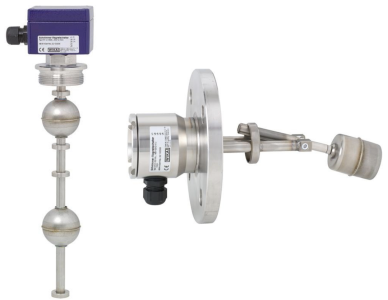
FLS (vertical) and HLS (horizontal) level switches
The FLS vertical level switch has a float, containing a permanent magnet, that moves dependably along the guide tube in response to changes in liquid level. A reed contact (inert gas type) is installed within the guide tube and is actuated through the non-magnetic walls of both the float and tube by proximity to the float’s magnet. This design utilizes magnetic actuation and a reed contact for non-contact switching, ensuring operation without wear and eliminating the need for an external power supply. Float switches are available with multiple switching points for interface detection between various media. Mounting is straightforward and maintenance is minimal, resulting in reduced costs for installation, commissioning, and operation.
The HLS-S horizontal level switch provides versatile monitoring of minimum and maximum levels. The float, attached to a swiveling lever, moves with the medium’s surface, triggering a reed contact via a permanent magnet when the preset level is reached. This non-contact switching requires no power, is wear-free, and supports universal signal processing, including direct PLC or NAMUR connections. Easy to install and maintenance-free, the HLS-S float switch keeps mounting and operation costs low.
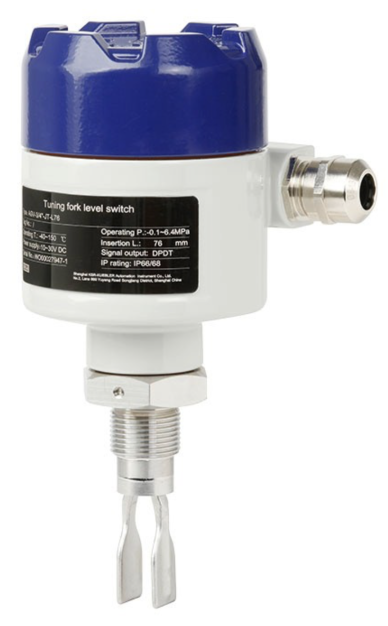
TLS vibrating (tuning fork) level switch
The principal component of the TLS-S vibrating level switch is a tuning fork with an integrated vibration drive. When the liquid level reaches and submerges the vibrating fork, its resonance frequency is dampened. The instrument’s electronic circuitry detects this decrease and converts it into a switching signal. Accurate detection of level changes is ensured regardless of the mounting position. To change the switch point, simply lengthen or shorten the pipe. High-point accuracy is achieved through 10 selectable sensitivity levels for application-specific adjustment. Additionally, the TLS-S can be configured to switch immediately or with a 1…20 second delay. (In turbulent or foamy media, a preset delay allows time for the output signal to stabilize so as to avoid false readings or intermittent switching. In calm tanks, there is no need for a delay.) Explosion-protected versions are available for operation in hazardous environments.
WIKA USA, Experts in Upstream Level Measurement
Keep your production storage tanks operating safely and efficiently with robust level sensors and reliable level switches. For more information about these or other instruments, contact the upstream oil & gas specialists at WIKA USA.
Products mentioned in this article
• LS-1000 submersible pressure sensor, for general applications
• LF-1 submersible pressure sensor, for superior applications
• LevelGuard anti-clog attachment, for submersible liquid level pressure transmitters
• DPT-20 differential pressure transmitter
• FLM-TB magnetostrictive level transmitter
• FLM-Tx-FLEX magnetostrictive level transmitter, flexible version
• FLS float switch, for the process industry, vertical installation
• HLS float switch, for the process industry, horizontal installation
• TLS-S vibrating level switch
For more information, contact WIKA USA.