

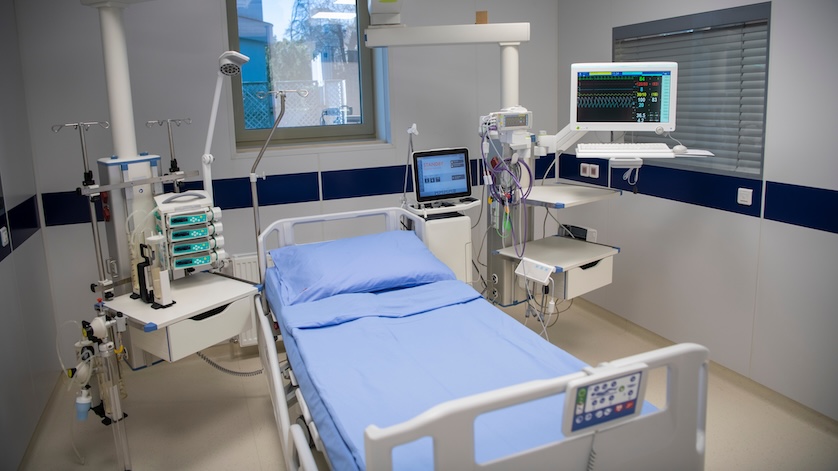
Hospital beds with integrated weighing systems allow healthcare professionals to better monitor and care for their patients. WIKA offers a wide range of load cells, as well as advice on sensor placement and interfaces, for manufacturers of hospital beds, NICU cribs, and bed scales.
Updated Jan. 12, 2026
Healthcare facilities rely on a variety of tools to continuously monitor the condition of their patients. Increasingly, hospital beds are an essential part of that monitoring system. With a network of sensors, smart beds can measure sleep quality, detect motions that indicate bed occupancy, cardiac/respiratory distress, and other vital signs, then transmit that data to a medical unit’s central monitoring station.
Reasons to Integrate Weighing Systems in Hospital Beds
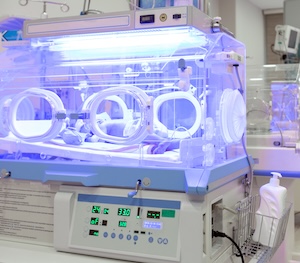
Precision scales in a NICU bed make it easy to monitor a premature baby’s weight.
Load sensors, in particular, play an important role in the care of non-ambulatory patients. In NICU beds, precision scales make it easy to see whether a premature baby is gaining or losing weight. In surgical and recovery rooms, beds with built-in weighing modules allow providers to administer the appropriate amount of medication or anesthesia, as well as to monitor fluid intake, loss, and retention. There is also the issue of dignity, as moving adults with obesity or limited mobility can lead to feelings of embarrassment or shame.
Hospital beds with integrates scales eliminate the need to physically move a person to measure their weight, thus saving time and enhancing safety for both patients and nurses. For these and other reasons, medical facilities from hospitals to senior homes are upgrading to high-tech beds.
What to Look For in Hospital Bed Load Cells
At the heart of a hospital bed weighing system are force sensors. Here are some considerations for choosing the right load cells for specific applications.
- Range: For adult hospital beds, choose load cells with a 0…550 lb. (0…250 kg) measurement range. Neonatal cribs should use load cells with a 0…7 lb. (0…3 kg) range. Bariatric hospital beds would benefit from load cells with a 0…1,100 lb. (0.500 kg) range.
- Force limit: Also called the load limit or overload capacity, the force limit is the additional force that a sensor can withstand without being damaged. In hospital bed applications, choose load cells with 120…150% Fnom.
- Accuracy: A hospital bed’s built-in scale should be accurate within 0.2–0.5 lbs. (0.09–0.23 kg), so choose load cells with a ±0.2% accuracy.
- Mechanics: Choose sensors designed to measure dynamic forces and that can be integrated into moving parts.
- Durability: A hospital bed weighing system is in constant use. For reliable performance and a long service life, choose a bending beam load cell made of stainless steel with welded bellows.
Where to Install Load Cell Systems in Hospital Beds
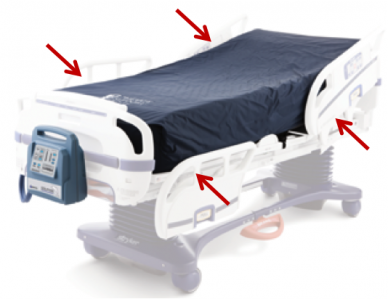
Most high-tech hospital beds have four load cells, one for each corner.
High-tech hospital beds use a variety of load cells. If mounting them between each caster wheel and its attachment point beneath the bed, use beam type load cells like the F3203 bending beam (OIML certified) or the F3833 bending beam, both with ranges up to 1,100 lbs. (500 kg). When the load cell will be installed between the lower and upper bedframe, planar load cells are better options due to their flatness.
Most hospital bed weighing systems have four load cells, one at each corner. (In practice, the number of load cells used depends on the bed’s size and the desired functionalities.) The precise location of each cell depends on how the bed mechanics, the number of sections, and how those sections tilt and move.
The summing box, also called a summing circuit, gathers the mV/V output signal from each load cell to calculate the weight. This component is usually placed in the middle of the bed, with the circuit transmitting the weight to the display panel. Since the summing box is not a force sensing mechanism, it can be located anywhere, including in the display or control panel.
Adding a microprocessor to the display panel greatly enhances capabilities beyond just weight measurement. Microprocessors can be programmed to process data from each load cell to detect, for example, if the patient is too close to an edge or might be in distress.
WIKA Sensor Technology, Expertise in Hospital Bed Load Sensing
Each manufacturer of durable medical equipment has different criteria for load sensing systems. That’s why OEMs frequently partner with WIKA Sensor Technology to source standard or custom load cells for their particular applications. In addition, our force specialists are happy to offer technical advice on proper sensor placement and integration of the summing box into display/control panels.
Our load cells and other force measurement solutions are produced at a state-of-the-art facility just north of Columbus, Ohio. This central U.S. location means that our customers in North America benefit from U.S. engineering, fast turnaround times, and local sales support. Streamlined manufacturing processes keep prices low, while the sensors’ high quality translate to a lower total cost of ownership.
Contact the experts at WIKA Sensor Technology for more information about our product portfolio and how high-quality load cell systems can help your hospital beds stand out from the competition.
Products mentioned in this article
• F3203 bending beam load cell (up to 1,100 lbs. / 500 kg), OIML certified
• F3833 bending beam load cell (up to 1,100 lbs. / 500 kg)