
This article is a continuation of “Industrial IoT for the Process Industry: The Why and How of IIoT Implementation.”
As process manufacturers implement industrial IoT in their facilities, they often come up against challenges. An experienced IIoT provider offers not only smart sensors and control systems, but also comprehensive solutions for making the most of the collected data.
Industrial facilities create demanding conditions for IIoT systems. The three main challenges are a processing plant’s hazardous areas, vast distances, and long life cycles.
1. Hazardous areas
Critical applications and processes are often in potentially explosive environments with strict safety requirements. Therefore, the sensors that gather data in those hazardous areas need to be certified as intrinsically safe or explosion-proof according to standards such as ATEX, IECEx, EAC, and CSA.
2. Vast distances
Many industrial plants are enormous, and extensive wiring would drive up costs and limit flexibility. Also, a network of pipes can span hundreds or even thousands of miles. In addition, certain sites are in remote outdoor areas with a limited local power supply and unreliable (or nonexistent) mobile connectivity. So, look for IIoT systems that are battery-powered, robust, and autonomous. Going wireless not only saves time and material expenses during installation, but also offers scalable connectivity across sites.
3. Long life cycles
The typical lifespan of a processing plant can be 50 years or more. When the technology used is not flexible, it becomes expensive and time-consuming to keep sensors and control systems up-to-date. Whether you’re planning a new facility or retrofitting an existing one with IIoT, opt for a complete solution that is modular and flexible, such as an asset monitoring system that uses NAMUR Open Architecture.
Applications That Benefit from Industrial IoT
IIoT has proven to be valuable in numerous industrial applications, optimizing asset management and increasing reliability and efficiency. And by being proactive rather than reactive, process industries can better plan their maintenance strategy and boost safety. Here are some use cases for a comprehensive IIoT solution.
Rotating machinery management
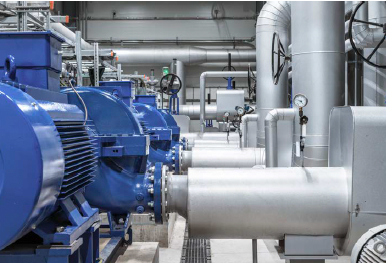
Continuous monitoring ensures the health of pumps, compressors, and other vital assets.
Pumps, turbines, fans, and compressors are vital pieces of equipment, yet 95% of them are left unmonitored. One reason is that they are in remote locations, such as relay pumps in an extensive water supply system. What’s more, rotating machines are especially prone to wear, tear, and – if not caught in time – failure. Costly downtime makes it even more crucial to monitor the condition of rotating machinery in real time.
IIoT SOLUTION: A system of multiple battery-powered (wireless) sensors enable remote monitoring and the early detection of anomalies. Any increase in temperature, vibration, or ultrasound waves indicates a potential issue. A LoRaWAN® (Long Range Wide Area Network) system is easy to install and deploy, and supports maintenance teams with insights gained through machine learning.
Oil and gas well management
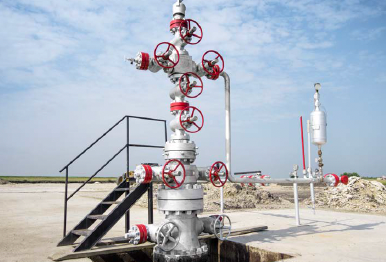
Remote well monitoring saves upstream operators time and money.
With today’s shortage of skilled laborers, it is becoming increasingly challenging for upstream businesses to ensure the integrity of their wells, especially ones located in remote areas. Infrequent inspections can mean that leaks remain undetected for weeks, causing operators to run afoul of environmental regulations. Manual monitoring is also costly, time-consuming, and not the most efficient use of personnel.
IIoT SOLUTION: A LoRaWAN® system enables the 24/7 well monitoring without cabling, including in areas without a local power or cellular signal. IIoT-enabled sensors continually collect data on tubing and casing pressure levels and the liquid level in well cellars. When measurements are outside of target parameters, the system triggers an alarm and automatically documents the incident.
Industrial gas cylinder management
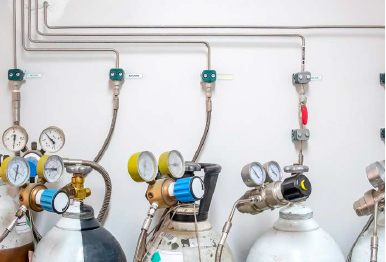
Wireless monitoring eliminates the need to manually check gas cylinder levels.
Batteries of gas cylinders, used for various purposes, are located throughout chemical plants. Manual inspections of cylinder levels – and their related logistics – take up employees’ time that could be better used elsewhere. (On average, a process plant spends over 2,000 personnel hours each year checking gas cylinders alone.) What’s more, occasional inspections do not allow for predictive analysis or data trending.
IIoT SOLUTION: A wireless monitoring system eliminates unnecessary on-site checks by alerting operators of near-empty cylinders. Remote pressure monitoring and automated documentation provide full oversight. A LoRaWAN-based solution is easy to integrate into an existing ecosystem, such as retrofitting mechanical pressure gauges with battery-powered IIoT devices.
These are just three areas where IIoT can upgrade your operations and boost profitability. Other applications include:
- Monitoring of double-walled pipes
- Measuring and monitoring the fluid level of production storage tanks
- Monitoring of coke formation in refinery units
- Steam management
- Valve management
Like oil, data requires processing to make it useful.
Going from Measured Value to Added Value
When companies think about their assets, they often envision tangibles like facilities, machinery, inventory, and employees. In today’s digital world, however, one of the greatest resources of any organization is data.
But information in its raw state is of little use. As British mathematician and data scientist Clive Humby famously said in 2006, “Data is the new oil.” After crude is extracted, it needs to be refined before it can be truly valuable. Similarly, after data is collected, it has to be properly processed before it can be truly useful.
To expound on Humby’s analogy, it matters how data is extracted. Trustworthiness is everything. First, data collection must be continuous. Second, the data collected must be accurate and precise. Thus, when implementing IIoT, it pays to invest in reliable, high-quality sensors, control system, and software.
WIKA USA, an End-to-End IIoT Solutions Provider
WIKA helps the process industry transform measured value to added value. As a leading provider of smart sensors and measurement solutions, we are uniquely positioned to do this. Our instruments are used in one billion total measuring points worldwide, with 50 million more installed each year. WIKA can also handle data processing utilizing machine-learning algorithms with select sensors. In a data-driven world, sensor manufacturers like WIKA are an integral part of Industrial IoT.
WIKA USA streamlines IIoT adoption with comprehensive services, from initial consultation and system design to implementation and post-deployment support. We leverage our national and global resources and expertise to offer cutting-edge technology, enhanced security, scalability, regulatory compliance, and ongoing maintenance. And by partnering with just one vendor, customers benefit from streamlined coordination and cost efficiency.
Industrial IoT is revolutionizing the process industry. WIKA is shaping the future of IIoT with sensors that are smart, connected, and built for tomorrow. Let us accompany your business on this journey. For more information, contact WIKA USA.