

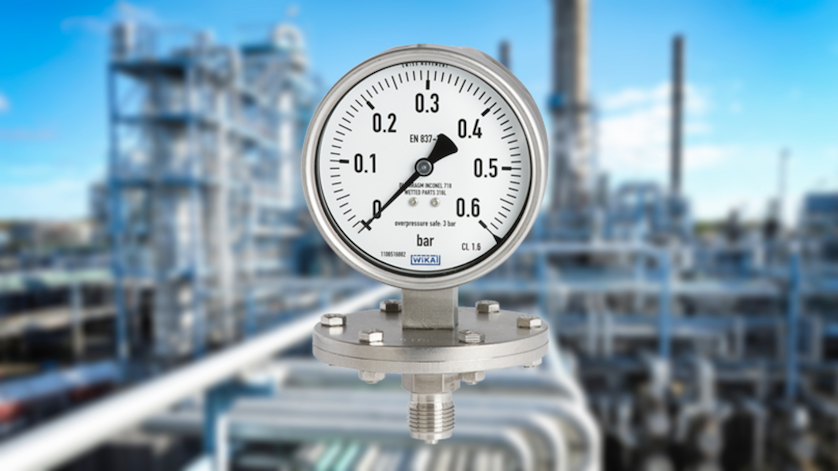
The flexible membrane of a diaphragm pressure gauge, as well as its specialized construction, gives it several advantages over other types of pressure gauges.
Process and industrial applications have a choice of pressure measuring instruments. Mechanical pressure gauges are especially practical, as they are robust, cost-effective, and do not require a power source to operate or to display a reading.
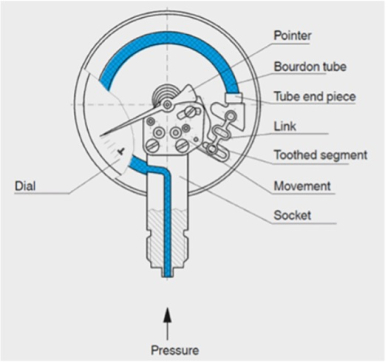
The internal workings of a mechanic pressure gauge
Types of Mechanical Pressure Gauges
There are four main types of mechanical pressure gauges, each with a different measuring element.
Bourdon gauges have a C-shaped, helical, or spiral tube that expands as pressure is applied, which causes a pinion mechanism to move. A direct drive gauge, whose pointer shaft is attached directly to the spiral or helical tube rather than to the movement, is a specialized type of Bourdon gauge. Since this type of pressure gauge requires the medium to enter the tube, Bourdon gauges are most suitable for gases and liquids that are not crystallizing or highly viscous.
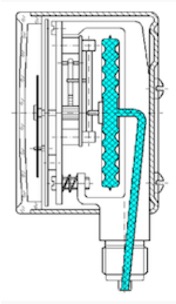
Inside of a capsule gauge
Capsule gauges have two corrugated discs that are fused together to create a circular capsule. The advantage of this sensing element is that it can detect and measure the slightest changes in pressure. Due to the measuring element’s positioning and the instrument’s very narrow pressure inlet, capsule gauges are best suited for dry gaseous media.
Bellows gauges have flexible, corrugated metal tubing that expands as pressure is applied. Note: WIKA does not manufacture this type of pressure gauge due to the bellows’ susceptibility to pressure spikes.
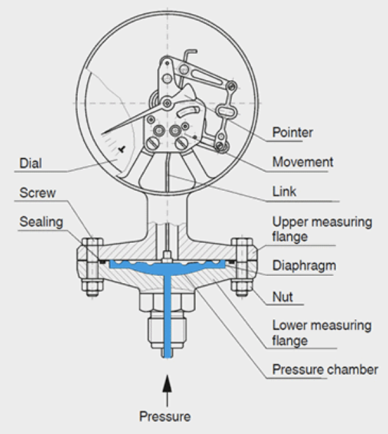
The internal workings of a diaphragm gauge
Diaphragm gauges have a thin corrugated metal disc as the measuring element. When pressure is applied to the flexible yet robust diaphragm, a link (connected push rod) moves the mechanism, transferring the pressure displacement to a pointer rotation. Since the diaphragm isolates the process media from entering the housing, and due to the larger cross-section of the pressure port, diaphragm gauges are ideal for measuring aggressive, viscous, crystallizing, contaminated, or hot liquids and gases.
Thanks to the sensitive diaphragm element, these types of industrial gauges can measure pressure as low as 10 in.H2O (25 mbar). They also offer good protection against overpressure since the diaphragm can support itself against the upper flange. Diaphragm pressure gauges are standard five times overpressure safe, and special versions are available with maximum overpressure safety up to 6,000 psi (400 bar), independent of the pressure range.
| Sensing | Types of pressure measured | Measuring range | Types of |
Bourdon pressure gauge | Bourdon tube: | • Gauge pressure | 0 … 10 psi to | All media |
Capsule pressure gauge | Capsule formed from two corru- | • Absolute pressure | 0 … 1 in.H2O to | Dry gases, |
Diaphragm pressure gauge | Diaphragm | • Gauge pressure | 0 … 10 in.H2O to | All liquids and gases |
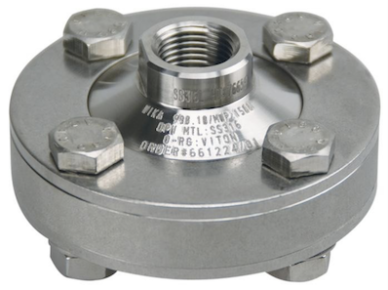
Diaphragm seal with
threaded connection
Diaphragm Gauges vs. Diaphragm Seals
Despite the similarity in names, diaphragm gauges are not the same as diaphragm seals. A diaphragm seal is an accessory mounted with a Bourdon tube pressure gauge, process transmitter, pressure switch, or another measuring instrument to protect its movement or sensor from extreme temperatures and/or aggressive media. The device cannot be used alone. The diaphragm seal’s design, material, and transmission fluid are optimized for each application.
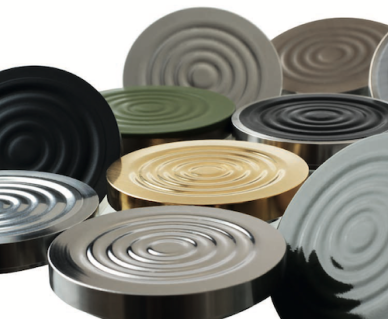
Diaphragm seals with
concentric grooves
On the other hand, a diaphragm gauge is a type of standalone pressure indicator that uses a diaphragm as the sensing element. In industrial applications, this diaphragm has grooved concentric circles, which creates a larger surface area for precise readings, excellent overload protection, and is available with special wetted parts and flanged connections.
Diaphragm Gauges vs. Bourdon Tube Gauges
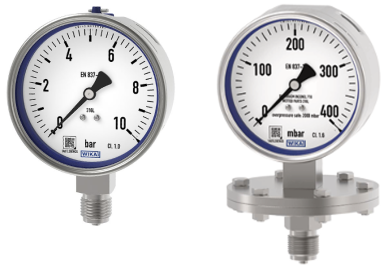
Bourdon tube gauge (left) and diaphragm pressure gauge
It is easy to distinguish diaphragm pressure gauges from Bourdon tube gauges. A Bourdon gauge (left) is the prototypical pressure gauge. A diaphragm pressure gauge (right) might resemble a Bourdon gauge at first glance, but it has a horizontal flange — made up of the upper and lower diaphragm housings — below the case.
The size of the flange depends on the pressure range. Ranges >100 in.H2O (250 mbar) require a smaller diaphragm (nominal size 4″, or 100 mm) while ranges ≤100 in.H2O (250 mbar) use a larger diaphragm (nominal size 6″, or 160 mm).
Diaphragm Gauges vs. Diaphragm Seal Assemblies
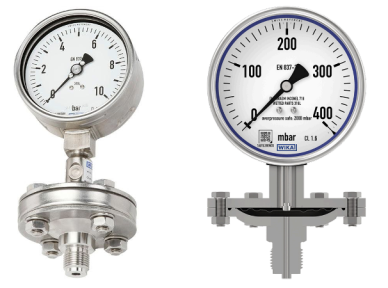
Diaphragm seal assembly (left) and diaphragm pressure gauge
Some diaphragm seal assemblies (left) may look like a diaphragm gauge (right), but they differ in their measuring principles.
As mentioned above, diaphragm gauges have a diaphragm as the sensing element. In contrast, a diaphragm seal assembly — also called a diaphragm seal system— is a Bourdon tube gauge or electronic pressure sensor that is mounted with a diaphragm seal at the factory. As such, pressure measurements are limited to the technical specifications of that particular gauge or sensor.
There are two main advantages of using a diaphragm gauge over a diaphragm seal assembly with a Bourdon tube gauge. Diaphragm gauges have 1) high overpressure ratings and 2) the capability of measuring pressures down to 10 in.H2O (25 mbar). But diaphragm gauges are not suitable for every task, as they are limited to only two types of process connections: threaded and flanged. Note: A third category of process connections, aseptic, is available in models PG43SA-C, PG43SA-D and PG43SA-S of diaphragm pressure gauges with a flush welded diaphragm element.
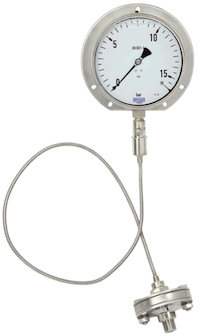
DS assembly with capillary
On the other hand, if a Bourdon tube gauge is paired with a diaphragm seal, it can be mounted remotely using a capillary to be away from the process side. This is an advantage if the pressure measurement location is near a heat source, does not have enough room for a gauge, or is not easily accessible to take readings. When accessorized with a device like the 910.32 cooling element/tower, diaphragm seal assemblies can be used in applications with extreme heat or cold. Furthermore, DS assemblies can be equipped with many different types of diaphragm seals.
| Advantages | Disadvantages |
Diaphragm gauge | • Suitable for all liquid, gaseous, & viscous media | • Limited options for process connections |
Diaphragm seal assembly | • Suitable for all liquid, gaseous, & viscous media | • Cannot measure pressure below |
Diaphragm Pressure Gauges by WIKA
WIKA offers a wide range of diaphragm pressure gauges for process industries. Available with either a dry case or liquid-filled case (for added protection against heavy pulsations and vibration), these instruments excel in measuring low pressure ranges. Use them in applications with highly viscous, crystallizing, or contaminated media, such as what are found in onshore and offshore drilling, water and wastewater treatment, chemical and petrochemical plants, and more.
- 30/433.30 and 432.50/433.50 diaphragm pressure gauges with up to 10-fold overload safety (maximum 580 psi / 40 bar)
- 36/433.36 diaphragm pressure gauges
- 50/453.50 diaphragm pressure gauges
- 56/432.36 diaphragm pressure gauges
For processes with hygienic requirements, such as what is found in biotechnology, pharmaceuticals, cosmetics, and food and beverage, the PG43SA family of diaphragm pressure gauges has a dry measuring cell (no transmission fluid) and flush welded diaphragm for sanitary process connections like clamp, threaded per DIN 11851, aseptic threaded, VARINLINE®, and BioControl®.
The bottom line: Between diaphragm gauges and diaphragm seal assemblies, not to mention a wide portfolio of pressure sensors and IIoT devices and services, WIKA offers pressure measurement solutions for pretty much any installation and application. Contact WIKA USA for more information on choosing the right pressure solutions for your specific applications.
Products mentioned in this article:
• 432.30/433.30 and 432.50/433.50 diaphragm pressure gauges
• 432.36/433.36 diaphragm pressure gauges
• 452.50/453.50 diaphragm pressure gauges
• 432.56/432.36 diaphragm pressure gauges
• PG43SA-C/PG43SA-D/PG43SA-S diaphragm pressure gauges, sanitary applications