
WIKA simplifies flow measurement procurement by supplying primary flow elements, transmitters, accessories, and customized assemblies through a single source. By providing compatible components as an engineered system, WIKA reduces sourcing complexity while minimizing configuration and installation issues that can affect flow measurement accuracy.
Why is flow measurement procurement so complex?
Flow metering assemblies aren’t easy to build. First, each one is unique to its application, with size constraints, specific process media, flow rates, pressures, temperatures, compliance requirements, and so forth. There are no one-size-fits-all flow measurements solutions. To a large degree, every flow metering solution is custom-engineered.
Second, multiple suppliers are usually involved in the process since few companies offer the complete range of components and services:
- Primary flow elements
- Customized pipe runs
- Ancillary instruments for measuring pressure, temperature, and density
- Electronic sensors for signal transmission
- In-house testing and calibration
- Installation and commissioning support
Working with multiple vendors creates complexity. From a bureaucratic standpoint, there are multiple quotes, extra meetings and emails, more documents to handle (contracts, purchase orders, invoices), and diverse terms and conditions. On the technical side are different systems and documentation, material and accuracy requirements, calibrations and standards.
Complexity takes more time while increasing risk. It also costs more money, as sourcing a single component or service from multiple suppliers wouldn’t net any discounts – not the way that bundling could. The solution is simple: partner with a single provider that offers complete flow measurement solutions.
What does a complete flow measurement solution include?
A complete flow measurement assembly typically includes a range of
- Components – primary flow element, tubing/piping, fittings, valves
- Measuring instruments – gauges and transmitters for pressure, temperature, density
- Protective devices for those instruments – diaphragm seals, thermowells
- Special treatments – painting, materials conditioning
- Services – nondestructive testing, calibration
- Documentation – testing results, certificates
Primary flow elements
The type of primary flow element incorporated into a flow metering assembly depends on the fluid characteristics, process conditions, installation space, pressure drop limits, desired accuracy, upstream and downstream pipe properties, and numerous other factors. The devices, which create conditions that allow instruments to measure flow rates using the differential pressure principle, include orifice plates (both single-and multi-hole versions), meter runs (also called meter tubes), Venturi nozzles (also called flow nozzles), Venturi tubes, Pitot tubes, cone meters, wedge meters, and special solutions such as WIKA’s HHR FlowPak® and HHR ProPak® flow meters.
Other components
The primary flow element is incorporated into a section of piping and attached using fittings like flushing rings, gaskets, studs, and bolts. Valves allow operators to regulate and direct fluid movement. Flow conditioners optimize the flow profile for more accurate and repeatable measurements. Seal pots are typically used to protect the differential pressure transmitter from the process fluid.
Measuring instruments
An essential part of calculating flow rates is differential pressure measurement. Some flow metering assemblies also require a fluid’s temperature and density. Therefore, a complete flow measurement solution using primary flow elements includes pressure sensors and/or pressure gauges, a process transmitter, and could include temperature sensors such as resistance thermometers, and density meters.
Protective devices
Measuring instruments, whether they are mechanical or electrical or mechatronic, need to be protected from aggressive media and extreme temperatures and pressures. When mounted with pressure gauges and process transmitters, diaphragm seals allow these instruments to operate away from challenging conditions. For probe-style electronic temperature sensors, thermowells shield the stem from adverse conditions while increasing their ability to withstand fast-moving and abrasive media.
Special treatments
Certain applications call for specific treatments:
- Pickling and passivation of stainless steel and other alloys to clean the material and increase corrosion resistance
- Painting as per onshore or offshore painting specifications
- Electrical heat tracing for specialty chemicals or cold weather
- Hot insulation for piping near boilers, cold insulation for liquefied gases
Services
After a flow meter assembly is built, the entire assembly undergoes a series of nondestructive evaluations(NDE) for quality assurance and compliance. These evaluations could include hydrostatic testing, pneumatic leak testing, radiography, magnetic particle testing, ultrasonic tests, dye penetration tests, helium leak tests, hardness tests, and flow calibration. Some assemblies also require positive material identification, post-weld heat treatment, and ferrite number check.
Documentation
A provider of integrated flow solutions should be able to issue all the documentation necessary for approvals and compliance, such as ISO certification by DQS, CE certification (PED), ASME S Stamp, ASME U Stamp, and EAC. Other documentation includes testing results, certificates of authorization, and proof of accuracy (post calibration).
How do single-source flow solutions simplify procurement?
When you work with just one supplier for all flow measurement components and services, you benefit by having to deal with significantly less paperwork. There’s also better coordination throughout the project, from front-end engineering design (FEED) through commissioning. After the project handoff, the same provider who supplied all the components can handle post-project maintenance, repairs, and recalibration.
WIKA is ideally positioned to be that single reliable source. We have one of the world’s largest portfolios of flow measuring instruments, especially primary flow elements, as well as large-scale manufacturing capabilities. Our U.S. and global presence, coupled with knowledgeable flow measurement specialists familiar with national and international standards, give us an exceptional ability to support EPCs and end users with both standard and nonstandard flow solutions. We are also proud of our value-added services, such as consulting and project management.
How does an engineered flow measurement system improve accuracy?
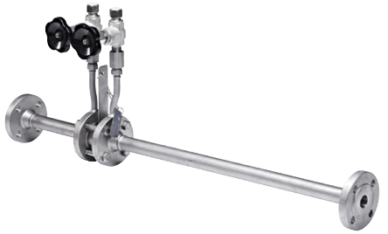
FLC-MR meter run
At a minimum, a flow assembly comprises piping, a primary flow element, fittings, valves, and instrumentation like a process transmitter. The more these components are selected and sized for a particular flow measurement system, the more compatible they will be with each other. Better system integration means fewer installation-related measurement errors.
For example, a meter run (also called integral orifice) like the FLC-MR consists of calibrated upstream and downstream pipes, an orifice plate, and two oval flanges or tubing with valves for a direct connection to a differential pressure transmitter. Since WIKA manufactures this meter run as one unit, all the components – as well as their materials and ratings – are optimally matched to eliminate the faults that create measuring inaccuracies. Indeed, the FLC-MR‘s accuracy is ≤ ±1.0% of actual flow rate, with a 0.1% repeatability of measurement.
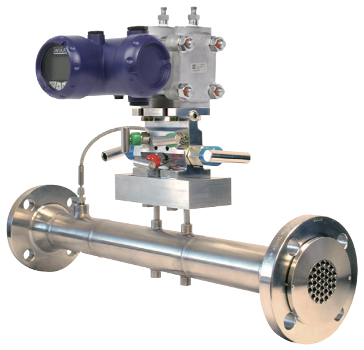
HHR ProPak flow meter mounted with a differential pressure transmitter
For an accuracy of up to ±0.25%, WIKA offers the specially engineered HHR ProPak™. This market-leading flow meter has low permanent pressure loss compared to most traditional primary flow elements, and functions without the need for straight upstream and downstream pipes. (High head recovery translates to greater energy efficiency and lower energy costs.) As a one-stop shop for flow measurement solutions, WIKA can mount this flow meter with one of our differential pressure gauges or transmitters, a probe thermometer with thermowell, gaskets, valve manifold, and all the studs and nuts for pipelines in accordance with customer requirements. Our certified flow laboratory conducts the calibration that supports your application-specific accuracy requirements.
Part of the HHR series, the HHR FlowPak® is another highly accurate differential pressure flow meter. Third-party testing confirms this metering technology’s performance in carbon capture applications.
How does WIKA customize flow solutions?
We build each flow assembly to a customer’s specific requirements, including with nonstandard options for the most demanding applications. Since WIKA is a leading manufacturer of all components related to flow measurement, our integrated flow systems are not only optimally compatible, but could reduce or eliminate the long wait times that come from sourcing components from multiple vendors.
Depending on its complexity, a custom-engineered flow assembly begins with a detailed questionnaire or a conversation with one of WIKA’s flow measurement specialists. We ask about plant- or project-specific specifics:
- Fluid type – liquid, gas, steam, single- or multi-phase
- Fluid data – flow rates, pressures, temperatures (minimum, normal, maximum, full scale)
- Piping – nominal size and pressure rating, material, sealing face type, upstream and downstream straight piping
- Required accuracy – uncalibrated or calibrated
- Material origin – no restrictions, with restrictions from certain countries
- Primary flow element – type, design, material, other characteristics
- Industry codes and standards – ISO, CE, ASME, EAC
For the most demanding applications, such as those with extremely high pressures and temperatures or challenging media, WIKA can manufacture the primary flow element, piping, fittings, and other components using special or exotic materials.
Real-world examples of integrated flow solutions by WIKA
Projects around the globe have relied on WIKA instruments and engineering expertise to measure flow in challenging applications. Here are two case studies.
Case study 1: Custom meter runs for a carbon capture project
In 2022, WIKA partnered with an EPC contractor to build custom flow assemblies for a major U.S. facility that captures and utilizes carbon dioxide as part of extracting helium and natural gas. The project specifics:
- Process medium – liquid CO2 under 5,076 psi (350 bar) of pressure
- Temperature – 95°F (35°C)
- Flow rate – 336,593 lb./h (16.598 kg/h)
The integrated flow solution was dual-chamber orifice assembly for DN 8″ Class 2500 pipe section, and used the following WIKA instruments:
- FLC-MR meter run
- FLC-OP orifice plate
- DPT-20 differential pressure transmitter
- xS digital temperature transmitter with HART® communication protocol
Case study 2: A compact, accurate flow meter for industrial gas tankers
A global industrial-gases supplier was dissatisfied with the low (±2.5%) accuracy of its flow meters during custody transfers. When the company’s engineers asked WIKA to build a better flow measurement system for the tanker trucks, they requested the following:
- Accuracy of ±1.0%
- Compact size for mounting in transport vehicles with limited space
- Durability, as the gas tankers sometimes have to travel on uneven, unpaved roads
- Versatility, as one assembly has to measure the flow rate of three liquefied gases: nitrogen, oxygen, and argon
- Suitability for cryogenic applications, with temperatures as low as −301°F (−185°C)
- Suitability for small pipes – DN 1½”
After collaborating with the gas supplier on several prototypes, WIKA satisfied the company with a robust flow solution that had the desired ±1.0% accuracy, versatility, and no moving parts. The flow meter’s all-welded stainless steel construction made it suitable for all three cryogenic gases, and the assembly measured just under two feet long (60 cm), which fit perfectly in the allotted space.
The right flow measurement assemblies for your applications
WIKA specializes in engineering plug-and-play solutions that reduce integration and commissioning costs. We have worked with companies in numerous sectors, from pulp and paper and refinery applications to coolant distribution units in data centers.
Thanks to our comprehensive portfolio, technical expertise, and global manufacturing capabilities, our EPC and industry customers benefit from high-quality flow assemblies without the complexities and expenses that come with having to deal with multiple vendors. Your flow assembly solutions are built to the application’s specific requirements, and then delivered on time. Contact us for more information on built-to-order flow measurement solutions.