
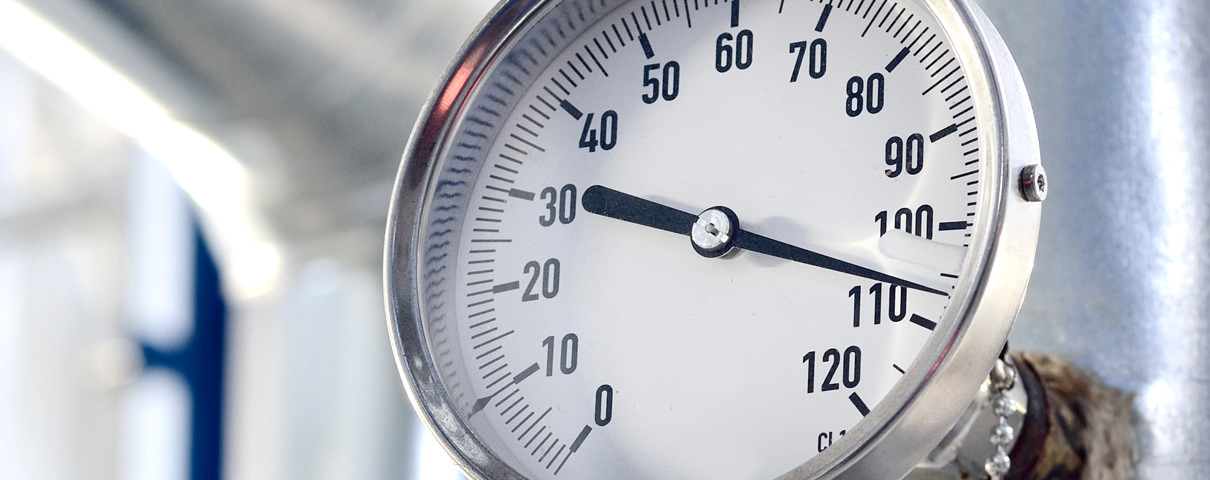

Condition monitoring is key to safety and efficiency in the process industry, but the tendency of electronic thermometers to drift under certain conditions means the temperature data that operators receive isn’t always reliable. WIKA solves this problem with an innovative RTD assembly that immediately alerts users of the smallest sensor drift throughout the measuring range.
Condition monitoring, also known as predictive maintenance, is the backbone of smart facilities. By keeping a digital eye on various parameters, process plants maximize safety and efficiency while minimizing unplanned downtime, which can be very costly in terms of labor and lost production. Condition monitoring also means lower maintenance costs, since inspections, repairs, and replacements are driven by demand rather than conducted on a set schedule.
Temperature is an especially important parameter to monitor. There can be thousands of measuring points in just one process, with about 20% classified as safety relevant. Just one false alarm from a critical sensor results in unnecessary downtime. As a result, plant operators are placing a greater emphasis on reliable instruments, such as SIL-rated temperature probes.
However, even high-quality electronic temperature instruments have a tendency to lose their accuracy due to drift.
Drift in Temperature Sensors
Resistance thermometers, commonly referred to as RTDs (resistance temperature detectors), are rugged and reliable. They hold up extremely well in high-vibration applications and offer excellent accuracy – up to class AA in 4-wire RTDs. Thin-film resistors, where the wires are sandwiched between a ceramic base and a fine layer of platinum, are popular due to their small mass, vibration resistance, and lower cost.
At the same time, RTDs have a tendency to drift under certain circumstances:
- Mechanical stress
- Moisture entering the sensor
- Extremely temperature fluctuations
- Poisoning of the platinum layer by foreign atoms (contamination)
Permanent sensor drift has long been an issue. Regular service intervals used to catch these and other issues. But with predictive maintenance, drift remains undetected until the next calibration date rolls around. (The recommended calibration interval for temperature instruments is one year.)
One way to ensure sensor accuracy is with more-frequent calibrations, but that’s an expensive and time-consuming process. Another way to detect sensor drift is for the temperature transmitter to compare the readings of two RTDs. The drawback with this second approach is that it’s not always easy to know which sensor is drifting. And if both sensors have similar drifts, this method wouldn’t necessarily detect a difference.
A better solution would be for a temperature transmitter to alert the control room whenever a particular sensor is drifting and by how much. Alas, no such technology existed in the market… until WIKA solved the problem.

WIKA’s True Drift Detection (TDD) assembly includes an RTD with special probe tip and the T38 temperature transmitter.
RTDs with True Drift Detection
WIKA has come up with a new design for RTDs that can detect even the smallest drift and immediately alert operators of the faulty status. True Drift Detection (TDD) is based on an assembly of two instruments:
- A thin-film resistance thermometer with a built-in reference element in the probe tip, like the TR10-X or TR15-2
- The T38 digital temperature transmitter with HART® communication protocol
When the sensor signal is processed, the transmitter immediately detects any deviation between the measuring element (internal leads) and reference element, then communicates this status via HART® or directly on the current loop. TDD monitors the entire measuring range of the sensor, from −122°F to 932°F (−50°C to 500°C), making it suitable for most applications in the process industry.
Probe Design for True Drift Detection

Internal view of the special probe with reference element
The probe tip is what sets a thermometer with TDD technology apart from standard RTDs. Its special design is based on the proven temperature measurement principle with a platinum resistor according to IEC EN 60751. The reference element is installed parallel to the platinum resistor in the probe tip for optimal measurement and monitoring results. The sensor has a resistance characteristic conforming to the standard, and the device always indicates the currently measured value. The underlying concept of the TDD technology prevents the reference element and its signal from averaging or distorting the measured value.
The sensor has a high load capacity, thanks to a metal-sheathed cable specially developed for True Drift Detection. Inside is a high-density ceramic insulation made of almost pure metal oxide powder that shields the internal leads both from each other and from the stainless steel sheath.
The TDD Sensor–Transmitter Assembly: How it works
Before assembling the unit, the TDD-enabled thermometer is calibrated over five measuring points, and the sensor and reference element are measured simultaneously. The result of the test is a polynomial with five coefficients that are programmed into the T38 temperature transmitter.
The T38 monitors drift using a smart algorithm, checking whether the difference between the values measured by the sensor and the reference element exceeds the application-specific limit value after correction with a balancing polynomial. The factory default is 1 K, but the value can be easily parameterized in the range from 0.1 K to 10 K.
Advantages of WIKA’s True Drift Detection Technology
Besides reliable temperature measurements and real-time notification of sensor drift, WIKA’s TDD assemblies offer other key benefits:
- This temperature measurement system is tailor-made for each application and ready to integrate into the process (plug and play).
- The TDD-enabled probe tip has the same size and geometry as standard RTDs, allowing for easy upgrades and without having to replace the original thermowell.
- Since this technology is an assembly of two components, repairs are less expensive. Simply replace the defective part, which is typically the sensor as its probe is closest to the high temperatures and pressures of the process. Then store its coefficients in the transmitter’s read-out unit via HART®.
The T38, a Powerful Temperature Transmitter for Process Industries

Head-mounted (left) and rail-mounted (right) versions of the T38 temperature transmitter.
WIKA designed the T38 digital transmitter to be a universal device with the maximum number of sensor connections, allowing it to be used with any type of electrical thermometer (including thermocouples) as well as to be configured for redundancies. With the head-mounted version, the T38’s trapezoidal terminal design offers a very large clamping area and access from the outside, enabling error-free connection of both the probe and the current loop. It is also available in a rail-mounted version. The choice of which transmitter type – head or rail-mounted – to use depends on the customer’s design. For example, rail-mounted transmitters are generally found in or around a control panel.
The T38 meets numerous regulatory standards for quality and reliability:
- Operation in safety applications to SIL 2 (single instrument) and SIL 3 (redundant configuration)
- TÜV-certified SIL version for protection systems developed per IEC 61508 (optional)
- Signaling in accordance with NAMUR NE43
- Sensor monitoring in accordance with NE89
- EMC in accordance with NE21
- Self-monitoring and diagnostics of field instruments in accordance with NE107
The entire assembly – not just the T38 transmitters but also the temperature sensor, its protective metal sheath, a neck extension (union), and termination head – is designed for safety and performance. A major U.S.-based chemical company has tested WIKA’S temperature assembly with True Drift Detection and plans to use it for certain applications.
WIKA USA, Your Partner for Smarter Condition Monitoring
WIKA’s innovative probe thermometers, now with True Drift Detection, allow the process industry to optimize plant safety with greater assurance of temperature monitoring accuracy. Contact the temperature specialists at WIKA USA for more information about how to incorporate this technology into your applications.
Products mentioned in this article:
• T38 digital temperature transmitter with HART® protocol
• TR10-2 industrial RTD assembly, spring loaded – head internal
• TR10-3 industrial RTD assembly, fixed – direct mount into process
• TR10-4 industrial RTD assembly, spring loaded – neck extension external
• TR15-2 industrial RTD assembly, remote mount