


Energy companies around the world, including in the U.S., have converted some of their petroleum refineries to produce renewable diesel instead. Others are planning to do so. Temperature monitoring of catalyst beds, using multipoint thermocouple assemblies, plays a key role in the efficiency of reactors.
More and more energy companies are diversifying by adding biofuel production to their portfolios. This move is part of a global trend toward greater sustainability, which creates business challenges but also new opportunities. One of those opportunities is carbon capture, utilization, and storage/sequestration. Another is the production of renewable diesel, a fuel in which waste vegetable oils and animal fats serve as feedstock.
Renewable diesel production can also make financial sense, as it is often a better use of underutilized or decommissioned plants. According to the U.S. Department of Agriculture, “renewable diesel production is anticipated to continue to grow and alter feedstock markets.”
Biofuel, Biodiesel, and Renewable Diesel: What’s the difference?
Although the terms biofuel, biodiesel, and renewable diesel are used somewhat interchangeably, there are subtle but important differences. Basically, biofuel is the broad category of renewable transport fuels made from organic materials. Within that category are biomethane and liquid biofuels.
Biomethane
Also called renewable natural gas, biomethane is produced by purifying the biogas emitted during the natural decomposition of organic matter such as animal manure, sewage, food waste, and agricultural residue.
Liquid biofuels
Liquid biofuels are made from either the sugars and starches from plant materials, or the oils and fats from plants and animals. This category of renewable liquid fuels includes
- Cellulosic ethanol – a fuel produced by fermenting corn grain, switchgrass, miscanthus (silvergrass), wood chips, crop residue, sugarcane, or another biomass with a high starch or sugar content. Since fuel ethanol has a high octane but is not as energy-dense as petroleum gasoline, it is often blended with low-octane gasoline.
- Biodiesel – a fuel produced by the esterification of used vegetable oils and leftover animal fats from meat processing. Biodiesel is normally blended with petroleum diesel to make it a viable transportation fuel.
- Renewable diesel – a fuel usually produced by hydrotreating and isomerizing used vegetable oils and animal fats; other methods include gasification and pyrolysis. Whether it is hydroprocessed esters and fatty acids (HEFA) or hydrogenation derived renewable diesel (HDRD), this biofuel is chemically identical to paraffinic diesel.
Renewable diesel holds great promise because it is a “drop-in” fuel. In other words, renewable diesel can replace conventional diesel without being blended and without having to modify engines, the fuel transfer infrastructure, or other aspects of the downstream value chain. In addition, the process for refining crude oil and bio-oil is similar, so it is relatively easy to modify a refinery to produce renewable diesel rather than petroleum diesel. According to the U.S. Department of Energy, the consumption of renewable diesel (almost all in California) has outpaced domestic production since 2013, and the country has had to import the balance from Europe.
Challenge: Precise Temperature Monitoring in Diesel Hydrotreaters
An energy company in the U.S. was already using WIKA instruments in its refineries. When it decided to convert one of its facilities to produce renewable diesel via HEFA, its engineers reached out to us for sensors to monitor the temperature of catalyst beds. The project entailed building a new three-bed hydrotreater and retrofitting an existing two-bed hydroisomerization reactor.
Temperature is a major determining factor in the performance of processing units like diesel hydrotreaters. Recycled cooking oil and animal fats undergo chemical reactions at temperatures between 805°F and 840°F (430°C to 450°C). For maximum safety and reactor efficiency, the exothermic process requires precise temperature monitoring. The energy company wanted a complete temperature profile along the catalyst beds for the early detection of hot spots, channeling, maldistribution, and other issues. Of special importance was radial temperature measurement in the lower area of the catalyst beds.
Solution: WIKA Multipoint Thermocouples, Temperature Transmitters, and Installation
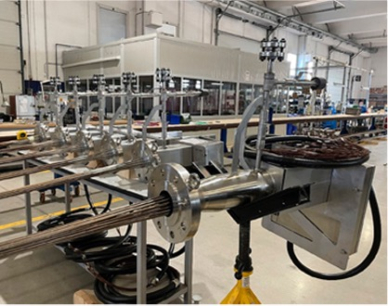
Several TC96-R Flex-R® multipoint thermocouple assemblies await delivery to a renewable diesel plant.
After examining the retrofitting and construction project, the electronic temperature specialists at WIKA came up with a complete package that included two types of multipoint thermocouples, the necessary transmitters, and installation of the temperature sensors.
The TC96-R Flex-R®radial multipoint thermocouple features an application-specific number of measuring points that can be positioned however the customer would like. The company ordered a 12-point thermocouple for each bed in the hydrotreater, and a 14-point thermocouple for each bed in the hydroisomerization reactor. The control room could see temperature changes in near real-time, as the reaction time of the Flex-R® is 4 to 8 seconds. These radial multipoint thermocouples were placed in the lower areas of the catalyst beds.

TC94 thermocouple assembly, T-bar design
For temperature sensing in the middle and upper areas of the catalyst beds, we recommended five TC94 multipoint thermocouple assemblies, each with three measuring points, for the reactors. The T-bar design of this temperature sensing solution allows the instruments to be mounted securely along the catalyst beds’ guide rails.
Corrosion is a real risk in units that process renewable diesel due to the diverse feedstocks’ higher water content. So, we designed a metallurgically superior temperature monitoring system where all wetted components of the multipoint assemblies are made of Inconel 625 for extra corrosion resistance. For signal processing, we recommended the T38 digital temperature transmitter with HART® protocol.
WIKA USA, Temperature Sensing Solutions for Renewable Diesel Plants
WIKA is a global leader in temperature monitoring systems for process industries. Of particular emphasis are electronic measurement solutions for oil and gas, petrochemical, and chemical processing. In addition, we are a trusted partner for companies seeking to move away from fossil fuels – as both feedstock and energy source – and toward hydrogen and renewables. Contact the temperature and process-instrumentation experts at WIKA USA for more information about complete temperature-monitoring systems for the production of biomass-based diesel and other biofuels.
Products mentioned in this article
• TC96-R Flex-R® multipoint thermocouple
• TC94 multipoint thermocouple, T-bar design
• T38 digital temperature transmitter with HART® protocol
[contact-form-7 id=”14552″ title=”Blog Contact Form”]