

During weighing, the weight force is measured, typically using scales. The mass is determined in two ways: comparatively or directly.
Comparative scales
As the goddess of justice in Roman mythology, Lady Justice is closely associated with Aequitas, the Roman law. Everyone knows her and how she weighs up the proportionality of judgements blindfolded on her balance scales. Similar scales have always been used to compare two masses directly with each other. The nice advantage of such pivoted balance beams is that they compare independently of local conditions. If you place equal weights on the right and left pan of the scales, the beam is balanced, regardless of whether you are at sea level, on a mountain top or even on the moon.
However, determining a defined weight can be difficult. Apart from the fact that, ideally, the fulcrum would have to be friction-free and that the surrounding air also exerts resistance that needs to be taken into account, reference weights are needed above all to weigh specific masses.
Measuring the weight force
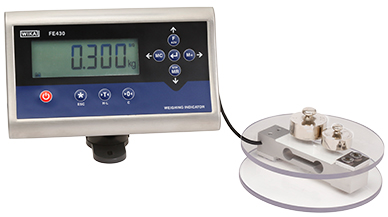
The model FE430 weighing indicator displays the weight placed on the scales
In order to be able to weigh without reference weights, spring scales were invented, which are commonly used today. Their main component is the so-called measuring spring, which is elastically deformed by the mass acting on it. This component may have the form of a classic spring, similar to those found inside ballpoint pens, or the technically optimised form of a load cell. If the mass to be weighed is placed on the scales or hung on it, the measuring spring is deformed proportionally to the weight force – a small weight results in a small deflection, while a large weight results in a large deflection. And if the second weight is twice as large as the first one, the deflection is also twice as large.
The underlying formula states that the mass (in g) corresponds to the ratio of weight force (in N) and gravitational acceleration (m/s²). (Other influencing factors such as hydrostatic buoyancy, magnetic or electrostatic interaction and time are negligible.) However, this also implies that the location has an influence on the weighing result; while the average gravity on Earth’s surface is 9.807 m/s², it can vary between 9.787 (at the equator) and 9.832 (at the poles).
Normally, scales do not change their location, meaning that the gravity remains constant. Due to the high precision of load cells, very high accuracies of about 106 can be achieved. Spring scales are therefore ideally suited for conventional measurements.
How to build scales
So basically, it is very easy to build scales. As simple as it is to hang up a balance beam and compare weights directly with each other, it is just as easy to mount a load cell and connect it to a display. It is usually calibrated with a zero point and a known reference weight and you are ready to start weighing.
Note
Further information on our product range for weighing technology can be found on the WIKA website. If you have any questions, your contact will gladly help you.