
An essential step in the production process of pressure gauges is the leak test of the measuring system to ensure that the process medium does not escape into the environment. There are, however, significant differences in how leak tests on stainless steel pressure gauges are implemented on the market. These differences have a direct influence on the quality of the instruments – and thus on process and user safety.
Leak testing identifies leakage in the measuring system
In stainless steel Bourdon tube pressure gauges, for example, the measuring system consists of the process connection, the Bourdon tube and the end piece. These components are welded together in the production process and are then subjected to a stringent leak test. Since the measuring system will later be exposed to pressure and come into contact with media, it is therefore of great important that it has a high level of leak tightness – especially with flammable, explosive or toxic media.
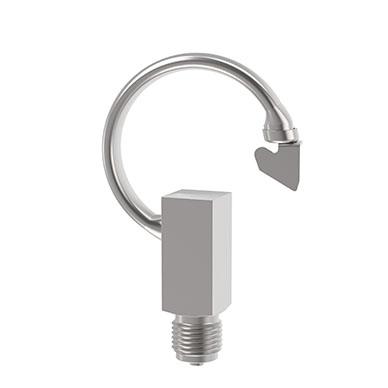
The measuring system of a stainless steel Bourdon tube pressure gauge consists of a process connection, Bourdon tube and end piece.
A leakage occurring in the measuring system can have serious consequences:
- Danger to personnel and environment due to leakage of (hazardous) medium
- Loss of (expensive) process medium
- High maintenance costs or even shutdown of the plant
- Damage to the environment (fugitive emissions, toxic substances)
High leak tightness in pressure gauges therefore increases safety, guarantees smooth processes and reduces downtime. A leak test that identifies even the smallest leaks is therefore an important quality feature.
Leak tests at WIKA: 1,000 times tougher than required by standards
Helium leak testing is one of the most demanding and reliable methods for detecting leaks. WIKA therefore uses this proven method as standard in the manufacture of stainless steel pressure gauges, achieving an industry-leading leakage rate of 1 · 10-6 mbar · l/s. During this test, the measuring system is pressurised at nominal pressure with helium in a previously evacuated chamber. A leak detector then scans the vacuum chamber for escaping helium. As this method is particularly demanding and precise, it is associated with high costs for the manufacturer – from the investment costs for the testing equipment to maintenance and the use of helium as an expensive tracer gas.
Relevant standards such as the European EN 837-1, the American ASME B40,100 and the international ISO 5171 only require a leakage rate of 5 · 10-3 mbar · l/s regarding leak tightness. The most common leak tests in the market – the water bath test (the so-called bubble test) and the pressure-drop test – “only” achieve a detectable leak rate of 10-3 mbar · l/s and are usually not performed at nominal pressure. In addition, the bubble test is significantly more prone to errors, as small leaks in the water bath can easily be overlooked by the human eye. In contrast, a helium leak test is offered by most manufacturers only optionally and at an additional cost.
With 1 · 10-6 mbar · l/s at nominal pressure, the standard helium leak test at WIKA is therefore 1,000 times tougher compared to the standard requirements and common industry methods. This means that leaks can be detected that are 1,000 times smaller in relation to the volume flowing through per second. This can be crucial, especially in applications where even microscopic leaks can lead to contamination, pressure losses or safety risks.
Practical example illustrates the effects of different leakage rates
An example shows what this difference means in practice for a gas application, for example with ethylene and a process pressure of 10 bar (145 psi):
|
Leakage rate |
Hole diameter |
Description of gas leakage |
Gass loss |
|
5 · 10-3 |
~ 6 µm |
1 cm3 gas loss in 1 minute |
~ 497 litres |
|
1 · 10-6 |
~ 0,1 µm |
1 cm3 gas loss in 3 days |
~ 0.1 litres |
This illustrates how important precise leak testing is for the quality and safety of stainless steel pressure gauges. WIKA uses the helium leak test as a method to offer users the greatest possible protection against leakage.
Note
Further information on pressure gauges and other pressure measuring instruments can be found on the WIKA website. On the website, you can also learn more about WIKA as a company. If you have any questions, your contact will gladly help you.
Also read our posts
Stainless steel pressure gauges: Facelift brings digital features
Stainless steel pressure gauge in safety version: Selection guide
Switch contacts make pressure gauges and thermometers “active”