

Today’s light water reactor (LWR) nuclear power plant fleet relies on level measurement devices to track quantities of reactor coolant, spent fuel pool water, and other liquids. Under normal conditions, electronic level sensors continually transmit data to the control room, informing operators and technicians that liquid levels are appropriate. During severe conditions, such as a LOCA (loss of coolant accident) or BDBA (beyond design basis accident), it is likely that station power is out, transmitters are offline, and standard instruments are degrading due to increased amounts of radiation.
When digital systems in a plant go dark, operators still need to know the cooling water level, and whether that level is rising or falling. This critical need is why WIKA created the N-ALM, our accident-proof level measurement solution for safety and control systems. This sensor is designed to operate under the most extreme circumstances, when other measurement devices have failed.
Where level measurement matters most: three critical areas in a nuclear plant
There are three locations in a nuclear power plant where accident-condition level measurement is critical: reactor vessels, containment buildings, and spent fuel pools. Depending on the light water reactor type – pressurized water reactor (PWR) or boiling water reactor (BWR) – and its containment design, each of these three areas has its own failure mode.
- Reactor pressure vessels (RPV): Depending on the RPV size, up to 15,000 gallons (56,780 liters) of water is constantly circulated to remove heat from fuel rods and to moderate their rate of reaction. (The thick-walled steel vessel is extremely pressurized to keep the water from boiling away.) If the coolant level drops, the fission rate risks exceeding safe levels, and the reactor could overheat.
- Reactor containment buildings: This airtight steel structure, built around the reactor pressure vessel, can be flooded from an outside water source (river, lake, ocean) during a loss of coolant accident. A level sensor mounted on the building’s exterior wall measures how the planned flooding is progressing. Too little flooding, and the reactor core continues to melt down. Too much flooding, and the containment building’s concrete base could collapse.
- Spent fuel pools: Spent fuel bundles are stored under about 40 feet (12 meters) of water, which acts as both a coolant and a radiation shield. If this level drops, there might not be enough water to absorb the spent fuel’sresidual decay heat. Dangerous doses of radiation could also escape and reach people and the environment.
Requirements for a nuclear power plant’s level sensors
Across these three critical areas for cooling and radiation containment, electronic level sensors need to operate under not just normal conditions, but also accident conditions of elevated temperatures, pressures, radiation levels, and seismic activity. The N-ALM level sensor is designed with LOCA and BDBA in mind – and remains fully functional for up to one year after the incident.
| Parameter | Normal operating conditions (standard sensor) | Accident conditions (N-ALM sensor) |
|---|---|---|
| Temperature | 14–158°F (−10–70°C) | 14–482°F (−10–250°C) |
| Pressure | Ambient | 145 psi (10 bar) |
| Radiation dose | 16 MRad | 505 MRad |
| Seismic acceleration | 0.1–0.5 g | 2.5 g (standard), 5 g (upon request) |
Several other passively safe features help make the N-ALM the optimal level sensor for accident conditions at a nuclear power plant:
- No active electronics in the sensor or cabling for functionality during power outages
- No organic materials (plastics, elastomer seals) that break down in high heat or pressure, or after prolonged exposure to moisture and gamma radiation
- Fitted with a filter box (selected models) to protect the sensor against coarse debris during an accident or flooding event
For a nuclear power plant, level measurement in vessels and tanks requires accurate data on liquid thresholds and trending information, and also plausibility checks at the most critical moments.
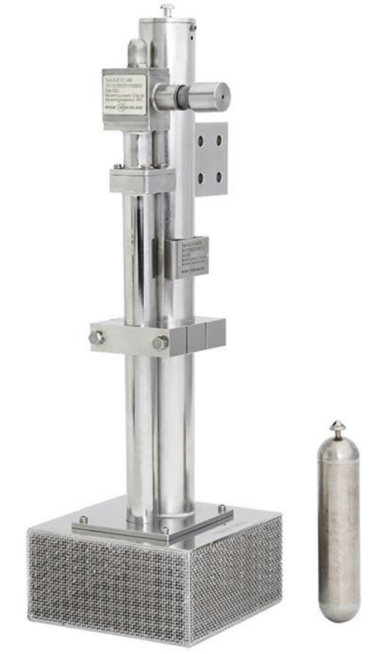
N-ALM level sensor for nuclear power plants, (right) magnetic float
The measurement principle behind the N-ALM level sensors
The N-ALM is a reed chain level sensor with all stainless steel construction. It is designed to remain reliable during accidents, as there are no components that would fail in extreme conditions. The technology is simple and effective, making reed switch units the ideal level measuring instrument in emergency situations.
The reed chain measurement principle: A float follows the liquid level. As the float moves up or down, its permanent magnet mechanically opens or closes the reed contacts of a closely stepped resistor chain. Depending on the position of the float, the total resistance changes, providing a virtually continuous signal without a single electronic component.
Power is needed only for signal transmission, not for measuring liquid levels. In normal operation, the signal is transmitted as an analog 4…20 mA to the control room. If the power supply fails, a technician manually connects a standard multimeter to the cable interface; 9V is sufficient to read the resistance value directly.
Each plant is unique – and needs specialized level solutions
Since different nuclear facilities have different operational, environmental, seismic, and licensing requirements, the N-ALM comes in numerous versions for all conditions: normal operation, outages, and accidents.
- N-ALM-D1: detects breaks in pipes or leaks in valves and pumps; for residual heat removal system and containment heat removal systems; equipped with filter box
- N-ALM-D2: detects leakage and accidental or intentional triggering of passive flooding valves into the containment’s spreading area
- N–ALM-D3: monitors the level of scrubbing liquid in the Venturi scrubber vessel
- N–ALM-D4: monitor the IRWST (in-containment refueling water storage tank) level; equipped with filter box and Pt100 temperature sensor
- N-ALM-D5: integrated inside spent fuel pools to monitor the coolant level, equipped with filter box and redundant measuring equipment
- N-ALM-D6: provides continuous level measurement during planned refueling outages in an empty or flooded RCAV (reactor cavity); equipped with Pt100 temperature sensor
- BLR-NK: provides water level information at the bottom of a reactor containment building, enabling the control of flooding under accident conditions; equipped with filter box; meets IEC/IEEE 60780-323:2016
No two nuclear facilities are exactly alike. Besides the PWR or BWR reactor types, there are varying water sources, room heights, vessel geometries, containment designs, accident management strategies, and existing hermetic feedthroughs for power and transmission cabling. That’s why WIKA customizes each level transmitter for a particular customer’s plant equipment, protocols, and other specifics.
When almost everything fails: lessons from Fukushima Daiichi
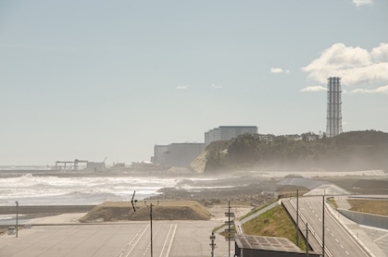
Fukushima Daiichi nuclear power plant in 2020
A beyond design basis accident (BDBA) is a scenario outside a plant’s original design and planning basis, and it’s exactly what the Fukushima Daiichi nuclear power plant experienced. On March 11, 2011, a magnitude 9.0 earthquake struck Japan. The reactors shut down as designed in the event of an earthquake. However, the resulting tsunami inundated the plant and knocked out the electricity and cooling circuits. Three of the reactors overheated, and those high temperatures accelerated the reactions that produced a significant amount of hydrogen. The gas exploded, damaging the entire plant and releasing radiation to the surrounding area. Nine months passed before Fukushima Daiichi could be brought under control (source: Nuclear Energy Agency).
For nine months, plant personnel faced a question that no digital system could answer: How much cooling water was in the station’s six reactors, and were the levels rising or falling?
In the aftermath of this Level 7 nuclear and radiological event, national and international nuclear agencies, including the International Atomic Energy Agency (IAEA) worked to understand what failed and how to prevent it from happening ever again. In the U.S., the Nuclear Regulatory Commission contracted with the National Academy of Sciences (NAS) to study Fukushima and come up with recommendations.
The 2014 study listed eight failures. Failure #5 relates to instrumentation: “Operators … lacked adequate procedures and training for accidents involving extended loss of all onsite AC and DC power, particularly procedures and training for managing water levels and pressures in reactors and their containments and hydrogen generated during reactor core degradation” (source: National Institute of Health).
The N-ALM level sensor meets the following specific recommendations from the NAS:
- Tools for estimating real-time plant status during loss of power
- Instrumentation for monitoring critical thermodynamic parameters in reactors, containments, and spent fuel pools
And per the IAEA and NEA (Nuclear Energy Agency), accident measurement technology generally needs to be engineered specifically for a plant, not a one-size-fits-all product pulled off a shelf.
Reliability when it matters most, engineered for your plant
Fukushima made two things clear:
- In extreme conditions, the most robust system outperforms the most sophisticated system.
- Currently operating plants need to take additional measures to upgrade their safety systems and further reduce core-melt risks.
At WIKA, we see ourselves as a nuclear facility’s project partner – not just an instrument supplier. Our power generation specialists are on hand, from the first engineering meeting through onsite installation and support. Our products and services are certified in accordance with ISO 19443. Applicable requirements can include NRC regulations, relevant IEEE standards, and your facility’s specific licensing basis. We’ll confirm which qualifications and certifications apply to your project once we understand your plant.
Easy to install, the N-ALM level transmitters can be part of a new plant’s design or retrofitted in an existing facility as part of its post-accident monitoring system. Provided that the engineering concept allows it, plants can often remain in operation during installation. For water-filled spent fuel pools that cannot be drained for radiation protection reasons, installation under operating conditions is not only possible but often the only option.
Contact us to learn more about customizing N-ALM accident-proof level sensors and other instruments for nuclear power plants.
Frequently asked questions (FAQ) about level sensing in nuclear power plants
What is a beyond design basis accident (BDBA)?
A BDBA is a serious incident that falls outside the scope of a nuclear power plant’s original design and planning basis, such as what occurred at Fukushima Daiichi after the combined earthquake and tsunami in 2011. Plants need instrumentation designed to remain functional under unplanned conditions, not just design basis accident (DBA).
Why can’t standard electronic sensors be used for nuclear accident monitoring?
Programmable electronics typically fail at radiation doses around 5 MRad. A BDBA can produce doses up to 505 MRad, along with high heat, pressure, and humidity that standard components aren’t built to withstand.
How can a level transmitter provide a reading when there’s no power?
A reed chain level sensor like the N-ALM converts float position into a resistance value. In normal operation, the instrument transmits a 4…20 mA signal to the control room. In the event of a power outage, plant personnel can read the resistance directly with a 9V multimeter connected to the cable interface.
Can a reed chain level sensor be retrofitted into a power plant?
Yes. Provided the engineering concept allows for it, nuclear power plants can frequently remain operational during an instrument install. This ability is especially critical in active spent fuel pools, which cannot be emptied for radiation protection reasons.