

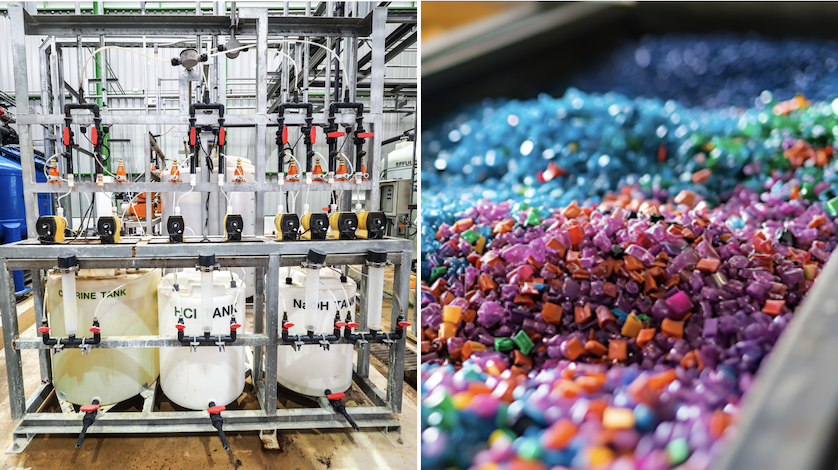
Radar is a smart way to accurately and continuously monitor the level of liquids or solids. For manufacturers, process industries, and OEMs, non-contact radar level sensors overcome the toughest measurement challenges.
The marketplace offers a wide range of instruments for measuring the level of liquids and solids, then transmitting that information to a control system. One of the most accurate and reliable technologies for level sensing available today is radar. It’s also highly flexible. Not only is radar indifferent to dust, moisture, vibration, temperature, and pressure, its contactless nature makes it the ideal method for measuring highly viscous or abrasive media, bulk solids, and other challenging materials. Non-contact also means no moving parts, no wear and tear, and no risk of contaminating the process media. And of course, radar sensors measure distances as well.
How do non-contact radar level transmitters work?
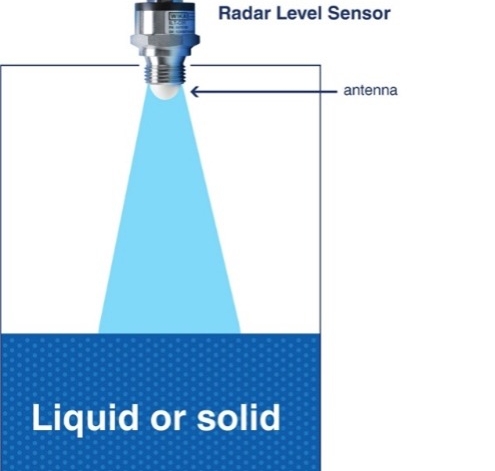
Non-contact radar level sensing
In simple terms, a radar-based sensor determines level by measuring the time it takes for electromagnetic waves to travel from the transmitter’s antenna and back, calculating the distance between it and a reflected surface, and then subtracting that distance from the known height of the vessel.
- Mounted at the top of a vessel, the sensor’s antenna directs either high-frequency pulses or frequency modulated continuous waves (FMCW) toward the liquid or solid.
- The radar waves travel freely at approximately the speed of light, reflect off the media, and are picked up by the antenna.
- The sensor uses FMCW radar technology to continuously analyze the frequency differences between transmitted and reflected signals, enabling precise distance measurement to the product surface
- The sensor then determines level by subtracting that measured distance from the known distance between the sensor antenna and the vessel floor.
Non-contact radar level transmitters work best in simple tanks but can be adapted for use with complex vessel geometries.
What are the advantages of using radar level sensors?
Non-contact radar level sensors offer numerous advantages over level measuring instruments based on floats, reed contacts, optoelectronics, ultrasound, guided wave radar, hydrostatic pressure, vibrating tuning fork, or other technologies.
Accuracy in challenging measurement conditions | • dusty environments |
High versatility | • wide range of liquids, including ones that are corrosive, abrasive, |
Compact size | • easy to transport and store |
Non-invasive mounting | • can be installed outside plastic and other non-metallic |
Radar vs. ultrasonic level measurement
Ultrasonic level measurement is also continuous, non-contact, and maintenance-free, and the working principle is like that of radar level measurement except sound waves are transmitted rather than electromagnetic waves. However, ultrasound signals are not as robust as radar signals.
Ultrasonic level sensors work well in simple, calm environments. But if a vessel contains foam, vapors, condensation, oil mists, or dust, those elements scatter or absorb the sound waves. The result is inaccurate, inconsistent, or false level readings. And unlike radar waves, ultrasound waves do not readily pass through plastic, fiberglass, and other non-conductive materials.
What are the limitations of radar level sensors?
While contact-less radar sensors are highly versatile and accurate, they are not the optimal level measurement solution for every operating conditions or applications. This is because radar level sensors:
- Require a power source and wiring.
- Are not suited for measuring the level of low dielectric (<2) materials, which would allow electromagnetic waves to pass through rather than bounce off.
- Have difficulty with extremely complex tank internals, such as agitators or other dense obstructions that cause false echoes.
- Denser and more robust foam
This two-part series continues with a detailed look at WIKA’s ILT radar level sensors for industrial applications.