

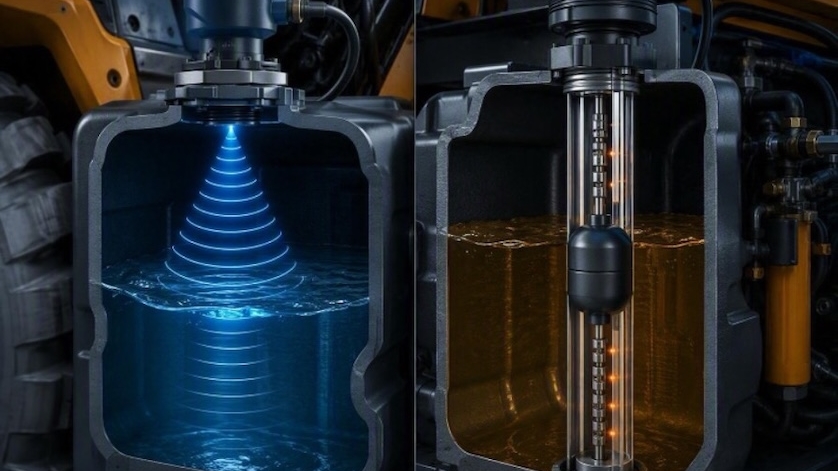
Compact radar level sensors offer important performance and reliability advantages over traditional float, magnetic float, and reed-chain technologies in harsh off-road applications. Because float-based systems rely on moving mechanical parts, they can stick, wear, break, or become damaged by fluid sloshing, vibration, and shock. Compact radar avoids these issues by measuring electronically without contact, making it resistant to vibration-related wear and capable of maintaining stable readings in dynamic operating conditions.
Why Radar Level Measurement Matters for Off-Road OEMs
Level measurement in off-road machinery has traditionally relied on float-based systems. In a typical reed-chain design, a float moves with the liquid level inside the tank, while reed switches convert the magnetic float position into a stepped electrical signal. This proven, low-cost approach is commonly used across off-road equipment, including fire trucks and agricultural sprayers.
Compact radar sensors give OEMs a higher-performance alternative as the technology becomes more affordable, reliable, and practical for mobile machinery. Installed at the top of a tank, a compact radar sensor uses microwave time-of-flight measurement to determine the distance from the antenna to the liquid surface. Because there is no immersed moving float, radar provides a clear reliability advantage while supporting the measurement performance expected in modern equipment.
Reed-Chain Float vs. Compact Radar Level Measurement
A reed-chain level sensor uses a magnet inside a float that travels along a guide tube. As the float moves up or down, the magnet activates reed contacts (switches) positioned at defined intervals. The resulting resistance, voltage, or current output represents the liquid level. Although magnetic coupling avoids a direct mechanical linkage through the guide rod, the system still depends on unrestricted float movement and multiple internal electrical components.
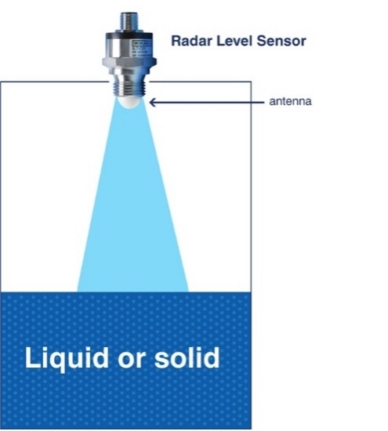
Non-contact radar level sensing
A compact radar sensor is mounted at the top of the tank and sends microwave signals toward the medium. The liquid surface reflects the signals back to the sensor, which calculates the distance to the surface and converts that measurement into a continuous level or volume value. This sensing principle eliminates the float, guide-tube travel path, and stepped switch spacing that define reed-chain architecture.
| Measurement feature | Reed-chain float | Compact radar |
|---|---|---|
| Measurement principle | Magnetic float with reed chain switches | Free-beam microwave |
| Measurement output | Incremental steps based on switch spacing | Smooth and continuous output signal |
| Moving or wetted parts | Float traveling along guide tube with reed chain electrical contacts | None |
| Exposure to media | Float and guide tube are immersed in media | No contact with media |
| Exposure to machine conditions | Subject to wear and breakage from sloshing, vibration, and shock | Not subject to wear and breakage from machine operating conditions |
| Compatible media | Free-flowing liquids compatible with brass or stainless steel | All liquid types regardless of viscosity or chemical composition |
Why Off-Road Machine Manufacturers Should Consider Compact Radar Level Sensors
Reed-chain float sensors remain economical for many applications, but compact radar sensors provide greater flexibility and performance benefits for off-road machine builders — especially in demanding environments.
No moving mechanisms
The most important advantage of radar level sensing is architectural simplicity. Compact radar has no float that must move freely, no guide tube that can bend or accumulate deposits, and no array of reed switches that must remain electrically intact. Eliminating these elements reduces the number of potential failure modes, especially in high-vibration, high-shock, or high-slosh applications.
Better resolution and continuous readings
A reed chain’s resolution is determined by switch spacing. In many off-road applications, typical resolution ranges from ½ inch (12.5 mm) to 1 inch (25.4 mm). Tighter spacing can improve resolution, but it also increases cost, especially in larger tanks. Compact radar provides a continuous reading, enabling smoother level indication, more precise volume calculations, and better estimates of range or remaining operating time. This benefit becomes especially important in irregularly shaped tanks, where software linearization can convert measured level into a more accurate volume value.
Reduced risk of sticking and buildup
Diesel sediment, wax, hydraulic sludge, and other contaminants can interfere with float travel or build up around the guide tube. Because radar sensors are contactless and measure from the top of the vessel, there is no mechanism moving through the fluid that can become stuck. This separation helps reduce incorrect level measurements, sticking risk, and ongoing maintenance in dirty or difficult tank environments.
Compatibility with challenging liquids and conditions
Tanks for DEF (Diesel Exhaust Fluid), also known as AdBlue, and other chemicals are often exposed to crystallization, deposits, freeze-thaw cycles, and corrosion — conditions that can affect float-based level sensor performance. Compact radar sensors eliminate the need for an immersed moving measurement element, making them well suited for applications where deposit buildup, aggressive media, or harsh operating conditions may be a concern.
Broader digital information and diagnostics
Radar sensors provide more than level or volume. Depending on the product architecture, they can also supply signal quality, echo confidence, sensor status, and diagnostic information. These data points improve fault identification and can support telematics, remote service, and predictive maintenance strategies.
Better support for next-generation mobile equipment
As mobile machines become more electrified, level measurement needs are shifting. While electrified off-road vehicles do not have fuel tanks, they still require monitoring for coolant, thermal-management fluids, hydraulic reservoirs, and auxiliary tanks. Autonomous equipment places an even higher premium on measurement confidence because an operator may not be present to recognize an implausible reading from a faulty sensor.
Why Radar Level Measurement Is Preferred in Critical and Severe Applications
Reed-chain systems are more vulnerable to vibration- and shock-related failures than non-contact radar because they rely on a moving float, guide tube, reed switches, and electrical connections. Liquid sloshing can cause repeated float movement and impact when the vehicle stops. Severe shock or slosh could bend the guide tube, while high mechanical stress are likely to damage glass reed capsules or solder joints. Over time, these failure points have a direct impact on machine reliability.
For compact and mid-range machines operating in mild conditions, a reed-chain level sensor may be sufficient. Radar’s durability and reliability advantages become especially valuable when equipment is needed during critical periods or seasons, or when assets utilization determines the profitability of large-scale operations.
| Feature | Radar level measurement | Float/reed chain level measurement |
|---|---|---|
| Accuracy / Resolution | High accuracy: ± ⅕ inch (5 mm) regardless of tank size | Resolution ranges from ½ inch (small to mid-size tanks) to 1 inch (large tanks) |
| Configuration(s) needed | One configuration for all tank sizes | Different configurations for different tank sizes |
| Durability | No moving parts to wear out or break | Float and reed chain prone to wear; shock and vibration can break reed chain |
| Effects of contact with media | No continuous contact with media | Continuous contact with media • Deposits prevent float from traveling freely • Freezing media can damage float and stem • Certain media can corrode float and stem over time |
| Liquid sloshing’s effect on reading | Can be filtered out electronically | Creates unstable readings |
| Connection(s) needed | ½-inch NPT female thread | • Large thread or 5-bolt SAE flange • In large tanks, two mounting points may be needed to secure guide tube |
| Size | Small compact form | Assembly sized to fit tank • Expensive to ship • Prone to damage from rough handling • Takes up significant storage space |
| Signal | 4…20 mA and 0…5 V DC | Resistance 3-wire potentiometric circuit (to keep cost low) |
Typical Machine Applications
Compact radar level sensors are ideal for almost every type of tank or reservoir in agricultural, construction and municipal machinery.
- Fuel tanks
- Hydraulic tanks
- Coolant tanks
- DEF (AdBlue) tanks
- Water tanks
- Brine tanks
- Chemical tanks
- Liquid fertilizer tanks
- Vacuum or suction tanks
- Bins and hoppers for solids or pellets
WIKA Level Measurement Solutions for Off-Road Machines
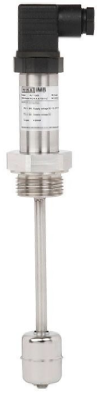
RLT-1000
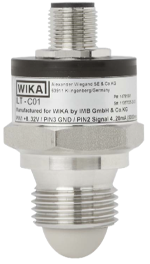
ILT-C01
WIKA provides OEMs with multiple level measurement solutions for off-road machinery. For simple, cost-effective applications—especially small tanks and reservoirs—the RLT-1000 reed-chain level sensor is a practical choice.
For applications requiring higher performance, especially in difficult or severe operating conditions, the ILT-C01 radar level sensor offers a more robust solution.
Contact us for more information about WIKA’s broad portfolio of level measuring instruments, especially our radar and reed-chain level measurement solutions, for mobile machinery. Our industry specialists can help you determine which technology is right for your specific applications.