


Certain process media can damage pressure gauges, which, in turn, can contaminate clean process media. By using a diaphragm seal as a protective barrier, plant operators save time and money by avoiding instrument damage, batch losses, and expensive downtime.
If the only medium that a pressure gauge had to deal with were clean water at room temperature, then there would be no need for diaphragm seals. But the reality is that industrial processes often involve fluids that are corrosive, viscous, silty, contaminated, extremely hot, or otherwise should not come into incompatible for direct contact with sensitive pressure instrumentation.

A diaphragm seal separates the medium from the measuring instrument.
Why Use a Diaphragm Seal
A diaphragm seal creates a barrier between the process medium and the internal mechanisms of a pressure gauge. Process pressure pushes against the diaphragm, which in turn displaces the hydraulic fluid inside a gauge to relay information to the instrument. This protective membrane is strong enough to withstand harsh media, yet thin and flexible enough to allow pressure to be transmitted to the instrument. Thanks to the diaphragm seal, process media never come into contact with the pressure gauge to clog or corrode its sensitive mechanisms.
Diaphragm seals also work the other way: by protecting the process from the gauge. Certain media, such as those found in pharmaceuticals and the food and beverage industry, cannot risk contamination. A diaphragm seal makes sure hygienic processes never touch the insides of a pressure gauge, which has cavities where product residue can pool, stagnate, and provide nutrients for microbes to grow.
In addition, diaphragm seals reduce potential leak points. Most pressure gauges are screwed onto piping; threaded joints are common sources of leakage, especially when they corrode. Flush-mounted diaphragm seals eliminates this source of fugitive emissions.
The Three Main Types of Diaphragm Seals
Diaphragm seals are categorized according to their process connection and mounting orientation. The three main types, or designs, of diaphragm seals are threaded, flanged, and in-line.
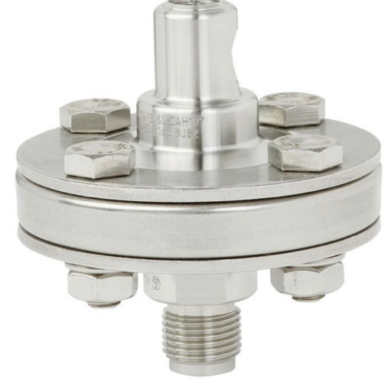
Threaded diaphragm seal
Threaded diaphragm seals
Threaded diaphragm seals protect pressure instruments from aggressive, corrosive, hot, toxic, and difficult process media. In high-temperature processes, capillaries and cooling elements, such as heat sinks, offer additional protection and increases measurement accuracy. With a female or male NPT or G connection, this standard design is suitable for low- to very-high-pressure service.
Threaded diaphragm seals are used in a wide variety of process conditions, thanks to an extensive range of configurations possible: materials and coatings, thread sizes and types, mounting, flushing, NACE options, and system fill fluids. Certifications for vacuum service, cleanliness, and more are also available.
The key advantages of threaded diaphragm seals:
- Compatibility with low and high pressures
- High corrosion resistance with numerous options for materials and coatings
- Smaller mounting geometry for tight spaces like narrow pipelines
- Easy to screw together and mount
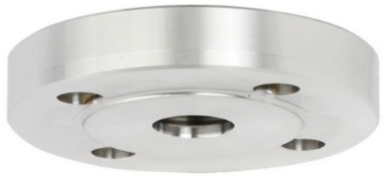
Flanged diaphragm seal with internal diaphragm
Flanged diaphragm seals
Flanged diaphragm seals are engineered to protect pressure measuring instruments in demanding process environments, such as what are found in the chemical, petrochemical, and oil and gas industries. This diaphragm seal design provides a robust barrier between the measuring device and aggressive, contaminated, or hot media, thus ensuring reliable and accurate pressure readings.
The key advantages of flanged diaphragm seals:
- Compatibility with low and high pressures
- High corrosion resistance with numerous options for materials and coatings
- Optional flushing connections for in-place cleaning and sanitizing
Flanged designs are available with either internal or flush diaphragms, supporting a wide range of process connections and standards such as ASME (American Society of Mechanical Engineers) and API (American Petroleum Institute). With a hygienic clamp, flanged diaphragm seals are ideal for sanitary processes. These features make flanged diaphragm seals a versatile and dependable solution for critical process applications. Certifications for vacuum service, safety integrity, and more are also available.
In-line diaphragm seals
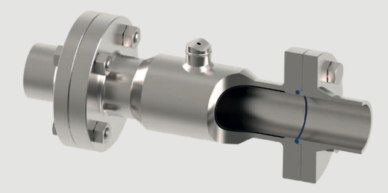
In-line diaphragm seal with flange connection
Available in a range of nominal widths, in-line diaphragm seals are directly incorporated into pipelines for measuring the pressure of flowing media. Flanges, threads, or clamps connect this specialized diaphragm seal to the pipe section on either side.
Because this type of diaphragm seal is smooth and completely integrated into the process line, there are no corners, dead spaces, or other obstructions that can hinder the flow or cause turbulences. These qualities also make in-line diaphragm seals ideal for pharmaceutical and food applications.
Regardless of whether the diaphragm seal has a threaded, flange, or in-line design, it is attached to a pressure gauge, or pressure sensor, or process transmitter in one of four ways:
- Directly welded
- Via a capillary tube
- Via a cooling element
- With a threaded adapter
Diaphragm Seal Fill Fluids: Purpose and Selection Criteria
Fill fluid transmits process pressure from the diaphragm to the measuring instrument. Choosing the right fill fluid is critical for ensuring compatibility with the process medium, temperature, and pressure conditions.
How to select the right fill fluid for a diaphragm seal
Each fill fluid has unique properties. When selecting a fill fluid for your diaphragm seal system, keep these five criteria in mind.
- The fluid’s temperature range — Each fill fluid has a specific minimum and maximum operating temperature. Exceeding these can reduce measurement accuracy while risk damaging the system.
- The fluid’s viscosity — The lower the fill fluid’s viscosity, the faster it can transmit process pressure from the diaphragm to the pressure instrument, especially at lower temperatures.
- The fluid’s density — When there’s a height difference between the diaphragm and the pressure instrument, such as when connecting the two components with a capillary tube, the system’s hydrostatic pressure is affected.
- Process compatibility — Fill fluids must not react with the process medium or the diaphragm seal system’s materials.
- Regulatory compliance— Food and beverage, pharmaceuticals, oxidizing applications, and other highly regulated applications have strict compliance standards.
Common system fill fluids for diaphragm seals
Operators can choose from a wide range of fill fluids, depending on the particular application requirements. The following are the most common fill fluids used in industries.
Fill fluid | Key characteristic(s) | Applications |
Silicone oils (KN 2, 17, 32, 68) | Wide temperature ranges | Universal use |
Glycerine (KN 7) | High viscosity, FDA-approved | Food, beverage, pharmaceuticals |
Halocarbon (KN 21) | Inert fluid for use with highly flammable media | Oxygen and chlorine service |
Methylcyclopentane (KN 30) | very low viscosity (0.7 cSt) and solidification point (−202°F/−130°C) | Liquid gas tanks, cryogenics |
Neobee® M-20 (KN 59), medicinal white mineral oil (KN 92) | high boiling/degradation point, FDA-approved | Food, beverage, pharmaceuticals |
Deionized water, DI water/propanol mixture (KN 64, 75) | For use with ultrapure media | Semiconductor, biotechnology, |
When to Use a Flushing Connection in a Diaphragm Seal
Incorporate a flushing connection into a diaphragm seal system whenever the process medium is aggressive, contaminated, viscous, or crystallizing, as buildup or blockages can impair measurement accuracy and damage the seal. Flushing connections are especially valuable in processes where the medium can solidify.
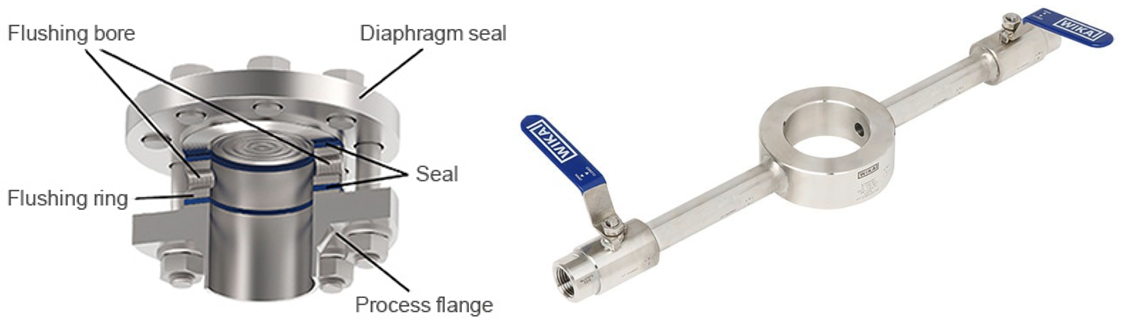
(left) diagram of a flushing connection, (right) two-bore flushing ring with mounted valves (click to enlarge)
A flushing connection is composed of a flushing ring sandwiched between the flanged diaphragm seal and the process flange, with sealing elements in between. The flushing bore can be on one or both sides of the ring, and this port allows operators to inject cleaning fluids or purge media directly into the process side of the diaphragm seal to easily remove deposits, residues, or blockages that may accumulate during operaon. Without a flushing ring, cleaning would require disassembling the measuring system — a time-consuming process. Plug screws (optional) seal the connection when flushing bores are not in use.
WIKA’s 910.27 flushing ring has threaded bores for mounting with a needle valve or ball valve. This flushing assembly greatly simplifies the process of regular cleaning and deposit removal. In addition, a bore-and-valve system enables operators to vent or drain the process medium, and to take product samples. With an upstream shut-off valve, a flushing assembly also makes it possible to calibrate the mounted pressure instrument without removing it.
Benefits of flushing connections
In summary, a flushing connection offers numerous advantages for process industries.
- Simplified process-side cleaning — Cleaning fluid flows through the flushing ring’s borehole and across the diaphragm surface to remove deposits.
- Greater measurement accuracy — By keeping the diaphragm surface clean, flushing connections ensure that pressure is accurately transmitted to the measuring instrument.
- Longer service life — With less product buildup to damage the diaphragm seal surface, a diaphragm seal assembly lasts longer before needing to be repaired or replaced.
- Safer operation — When the process medium is hazardous or aggressive media, a flushing connection enables cleaning without risking emissions and exposing workers to dangerous substances.
- Less maintenance and downtime — Flushing can be performed without dismantling the seal or interrupting the process, saving operators time and money. Calibrations can also be carried out at the measuring location without dismounting the instrument.
Diaphragm Seal Systems for Vacuum Service
Vacuum processes are essential in many industrial and biotechnology applications, such as vacuum distillation columns in refineries. Vacuum applications require systems that can measure absolute pressure. Since a perfect vacuum is not achievable in practice, most industrial vacuum processes operate at pressure of ≥ 2 inH2O (5 mbar) abs. — the low vacuum range.
Diaphragm seal systems can use various fill fluids for vacuum service: silicone oils, halocarbon, Neobee® M-20, medicinal white mineral oil. Note that a fill fluid’s boiling point decreases as pressure drops, affecting the measuring system’s performance.
When designing a diaphragm seal system for vacuum service, the key factors are process temperature, process pressure, production process, diaphragm diameter, and vapor pressure curve of the fill flid. The lower the pressure and the higher the temperature, the more challenging it is to design a reliable measuring assembly.
Diaphragm Seals Solve Pressure Measurement Challenges
Diaphragm seals are problem solvers in process industries, helping to measure and monitor pressure in demanding applications and environments. The use chart below lists some challenging process conditions and the recommended diaphragm seal solutions.
Diaphragm Seal Use Chart
Measurement | Diaphragm seal | WIKA diaphragm seal (DS) models |
Low pressure | Threaded or flanged | 990.40 threaded DS with range up to 1,450 psi (100 bar) 990.12/990.26 flanged DS with internal 990.41/990.68 flanged DS with internal |
High | Threaded diaphragm seal designed for welded duty, | 990.34 threaded DS with range up to ~14,500 psi (1000 bar), depending on wetted material, diaphragm diameter, and temperature 990.28 flanged DS with compact cell-type (sandwich) seals |
Abrasive, viscous, pasty, or crystallizing | Threaded or flanged | 990.36 threaded DS 990.27/990.28/990.29/990.67/990.69 flanged DS with flush diaphragm |
Sanitary processes | Threaded or flanged | 990.36 threaded DS with G 1 990.22/990.52/990.53 flanged DS with |
Hydrogen | Flanged diaphragm seal | any flanged DS with gold coating (6−25 μm, |
Very low temperature | Threaded or flanged | any WIKA diaphragm seal with methylcyclopentane fill fluid |
High-Performance Diaphragm Seals by WIKA

All-Welded System (AWS)
WIKA is a leading provider of diaphragm seals, many of which are manufactured at our state-of-the-art facility near the Houston Ship Channel. Our diaphragm seals and flushing rings come in multiple sizes, with various types of process connections, and can be made from a wide selection of materials to fit your particular application’s requirement.
For the most demanding applications, we offer the All-Welded System (AWS), where the gauge and DS are permanently fused to create one sealed pressure measuring instrument. This high-performance assembly is tamper-resistant and doesn’t allow access to the system fill fluid, thereby eliminating potential leak paths. The AWS is built to last even in extreme environments with high pulsation, thermal cycling, and overpressures.
Diaphragm seals are smart investments that help manufacturers protect both their pressure instruments and process media. For help in deciding which diaphragm seal is right for your particular application, contact the pressure measurement experts at WIKA USA.