
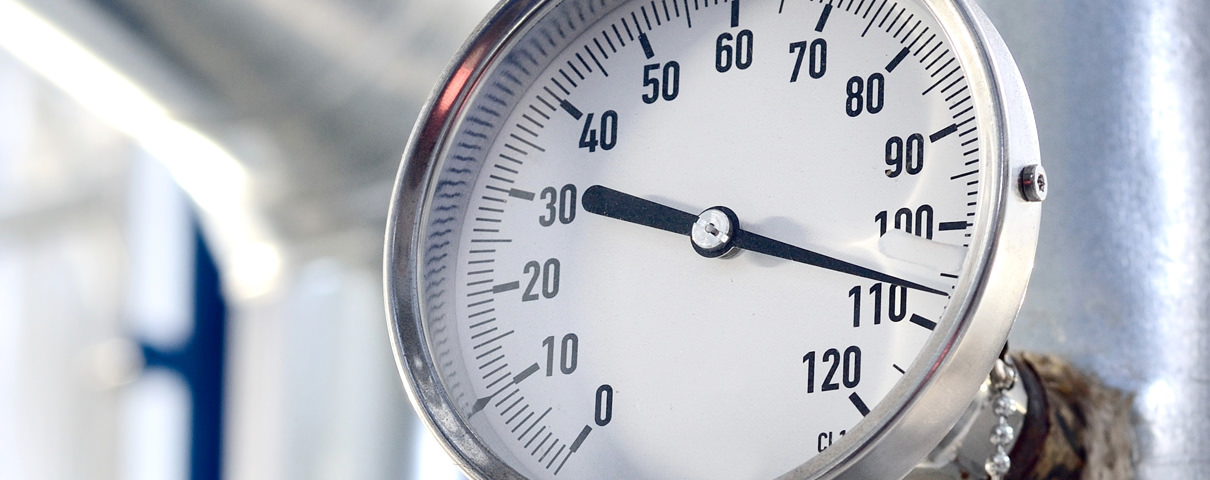

Wastewater lifting plants place high demands on level measurement: humid atmospheres, aggressive suspended solids, potentially explosive zones. The model ILT radar level sensor from WIKA avoids all that by measuring from outside through the container wall, without coming into contact with the medium.
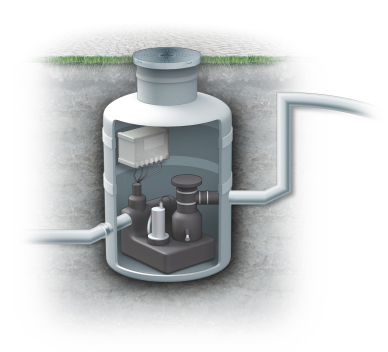
In wastewater lifting plants, sensors are exposed to adverse conditions.
Somewhere beneath a vaulted cellar, in the plant room of an apartment building or deep beneath a commercial site – where no one likes to look – wastewater lifting plants do their work. Their task is unspectacular but indispensable. They transport wastewater upwards into the sewer system, without the help of a natural gradient. Whether the pumps switch in time and prevent the chamber from overflowing depends on the quality of the level measurement.
Not a pleasant surrounding for measurement technology – which sensors are suitable?
The environment in wastewater lifting plants places high demands on every sensor. High air humidity, aggressive ingredients, grease, suspended solids and faeces take a toll on measurement technology when it comes into direct contact with the medium. In addition, digester gas turns parts of the interior into hazardous areas. Special approval requirements apply to such Ex areas, which represents additional effort for every sensor used. These include, for example, special instrument approvals (e.g. ATEX), adapted installation specifications such as intrinsically safe circuits, as well as additional documentation and testing effort.
Until now, float-based or hydrostatic sensors have generally been used. They are easy to integrate, operate on the “plug-and-play” principle and deliver robust and proven measuring results in many applications. However, in wastewater lifting plants they are immersed in the partly aggressive medium. This can lead to contamination and mechanical stress. In addition, adapting the instrument to different container sizes often requires different versions, which increases effort in warehousing and procurement.
How does level measurement from outside with a radar level sensor work?
The ILT-C01 industrial radar level sensor from WIKA takes a different approach. It is not installed inside the lifting plant but is mounted from the outside onto the plastic lid or the container wall. Radar waves in the 60 GHz frequency band penetrate plastic without problems and are reflected by the surface of the wastewater. Thus, the sensor, although never having contact with the medium, provides a precise, continuous level signal.
Prerequisites for measurement through plastic:
- The container is made of radar-transparent material (e.g. many plastic materials)
- The wall thickness is suitable for the radar frequency (typically in the millimetre range, depending on material and construction)
- There are no metallic layers or inserts present
- The mounting situation allows free propagation of the radar signal
As the ILT is installed outside the container, it is not located in the hazardous area. An Ex approval of the sensor is therefore simply not necessary. This significantly simplifies product development and approval for manufacturers and saves costs both for the sensor itself and in the documentation and certification process.
Non-contact, maintenance-free, robust
The maintenance effort is also reduced to a minimum with cleaning intervals, wear and unplanned failures due to deposits being eliminated because the radar signal never gets into contact with the medium. This applies regardless of how aggressive the ingredients are or how heavily the wastewater is contaminated with solids.
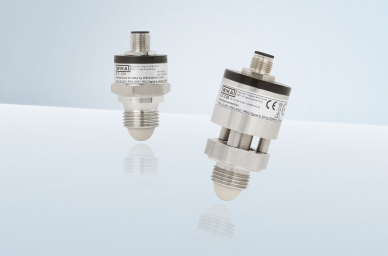
The ILT radar sensor from WIKA enables non-contact level measurement.
The sensor also offers high robustness against external influences; neither vibrations of up to 40g, field strengths of up to 100 V/m nor suspended solids or fat content in the medium affect the radar signal. IP67 ingress protection additionally ensures reliable outdoor operation in the long term.
One sensor for all container sizes
Wastewater lifting plants come in many sizes. Until now, this often required different sensor models, adapted to the respective container dimensions. The ILT overcomes this challenge with its adjustment function. The sensor can be adapted to the specific container geometry, suppressing interfering features such as stiffening ribs or cross-bracing, while adjusting the measuring range to 0 percent. One model, many sizes – meaning significantly less effort in procurement and storage.
With an overall length of only 49.5 mm and a G ½ or a ½” NPT threaded connection, the ILT also fits into limited spaces. Additionally, up to two switch points can optionally be integrated, for example for overflow protection or dry-run protection of the pump. In contrast to the significantly larger and more expensive radar sensors used in process instrumentation, the compact design was specifically developed for industrial applications with high volumes.
Conclusion: Less effort, more operational safety
The WIKA ILT opens up new possibilities for manufacturers of wastewater lifting plants, providing reliable, maintenance-free radar level measurement that does without Ex approval, is mounted on the container without requiring any cut-outs or openings in the container and covers all container sizes with a single model. This reduces complexity regarding procurement and operation and at the same time increases the operational safety of the plant. After all, the best sensor for the harsh conditions of a wastewater lifting plant is one that never comes into contact with them.
Note
On the WIKA website you will find further information on the ILT industrial radar level sensor as well as an overview of measurement solutions for water and wastewater applications:
- Product page: ILT – Industrial radar level sensor
- Application area: Water and wastewater
Also read our posts
Flame arrester protects sewage vacuum truck tanks
Sewage sludge: Using force measurement technology to monitor the thickening process
Grounding of hydrostatic level sensors