

The N-ALM level sensor from WIKA is a specialised instrument for level measurement in nuclear power plants. It operates reliably under LOCA and BDBA conditions, even in the event of a total loss of power supply. Containing neither active electronics nor organic materials such as plastics or seals, the sensor withstands nuclear operating conditions. The instrument remains functional for up to one year, while almost everything else has long since failed.
11 March 2011, Fukushima Daiichi. A magnitude 9.0 earthquake followed shortly afterwards by a tsunami suddenly faces operators with a question to which no digital system can provide an answer: How much cooling water is still in the reactor? Is the level rising or falling? Such moments define the highest demands of nuclear technology and what experts refer to as a beyond design basis accident (BDBA) – namely scenarios that lie outside any planning basis.
What counts when almost everything fails
Nuclear power plants go through various states during operation: from normal full-power operation and planned maintenance periods to design basis accidents (DBA), i.e. events for which a plant is structurally prepared. For scenarios beyond these limits, i.e. BDBA, measurement technology is needed that works when everything else fails. In severe accident management it is not millimetre-accurate values that are required, but trends, threshold values and plausibility. That is also how it is defined in the international standard IEEE 497.
At the same time, the measurement technology must withstand temperatures up to 250 °C, pressures up to 10 bar, air humidity of 100 % and intense radiation – for months, without external power supply. Any attempt to solve this using programmable electronics is bound to be unsuccessful. Such components already fail at around 50 kGy. In a BDBA scenario, radiation doses a hundred times higher, up to 5.05 MGy, are to be expected. In addition, according to the IAEA and NEA, accident measurement technology must always be designed specifically for the plant.
Level measurement in nuclear power plants: Three critical areas
For this task, WIKA has developed a specialised level sensor: the N-ALM level sensor with reed-chain technology for use in open tanks and pools as well as for applications with pressure vessels. The basic principle is simple. The sensor operates without active electronics and without organic materials such as plastics or seals, which can quickly lose their function under radiation, heat and moisture. This explicitly qualifies it for use under nuclear accident conditions. Depending on the reactor type (PWR or BWR) and the design of the containment, it is used in up to three areas, each with its own risk profile:
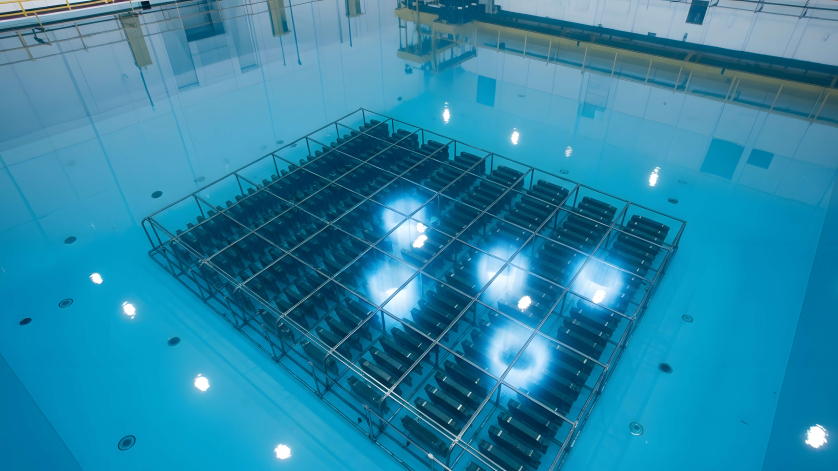
- Spent fuel pools: Spent fuel elements are stored under around 12 metres of water, which simultaneously serves as cooling and radiation shielding. If the level falls, the pool loses its shielding effect. Conventional sensors fail as soon as the radiation increases.
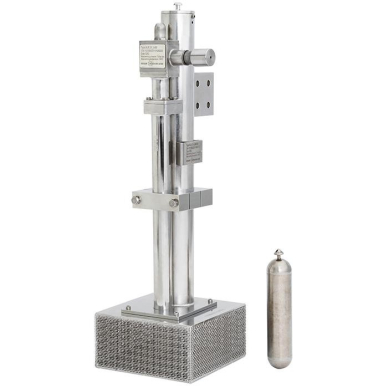
The N-ALM from WIKA is a specialised level sensor for nuclear applications.
- Pressure vessel: Indirect level monitoring to oversee the coolant inventory is the most critical measuring task of all.
- Flooding area in the containment: In the event of a loss of coolant accident (LOCA), the reactor building is flooded from the outside. The sensor mounted on the side of the wall measures how far the flooding has progressed. Too much water is just as dangerous as too little. The concrete base must not be overloaded.
In all three cases the same principle applies. It is not about measuring to the millimetre, but about having the right information at the decisive moment. This requirement shapes the entire philosophy of SAMG (severe accident management guidelines) and is the starting point for WIKA’s sensor concept.
The measurement principle: So simple that it cannot fail
WIKA’s answer is simple, and that is exactly its strength. The N-ALM does without any active electronics and organic materials. The principle: A float follows the liquid level. Its permanent magnet mechanically closes the reed contacts of a closely stepped resistor chain. Depending on the position of the float, the total resistance changes, providing a virtually continuous signal without a single electronic component in the containment.
In normal operation the signal is transmitted as an analogue 4 … 20 mA to the control room. If the power supply fails, an operator connects a standard multimeter to the cable interface. 9 V are sufficient to read the resistance value directly. The qualified limit values demonstrate the potential: an accident temperature of 250 °C, an accident pressure of 10 bar, a radiation dose of 5.05 MGy, seismic acceleration up to 5g and an accident service life of one year.
Every plant is different – and so is every solution
The reactor type (PWR or BWR), the design of the containment, accident management strategies, existing feedthroughs and room heights – all of that influences how a sensor can be installed. No nuclear power plant is the same as any other. Therefore, WIKA does not see itself as a supplier of standard products, but as a project partner. From the first engineering meeting through qualification per IEEE 323/344 and KTA to on-site installation support. Certified in accordance with ISO 19443 and KTA 1401.
The N-ALM can also be installed in new plants, but it is primarily designed for retrofitting. Provided the engineering concept allows it, plants can often remain in operation during installation. For water-filled spent fuel pools that may not be drained for radiation protection reasons, installation under operating conditions is not only possible but often the only option.
Conclusion: Reliability when it matters most
Fukushima showed the world that it is not the most sophisticated systems that make the difference in extreme situations – it is the most robust ones. WIKA’s N-ALM sensor stands for this conviction: maximum reliability through minimal complexity, combined with the engineering know-how that each plant needs for its specific requirements.
Note
On the product page you will find more specifications for the N-ALM. Further information on WIKA measurement technology for nuclear power is available on our website. Do you have any questions? Your contact will be pleased to assist you.
Also read our posts
WIKA certified in accordance with ISO 19443 for civil nuclear projects