


Data centres generate enormous heat loads. The coolant distribution units (CDUs) that control the heat rely on precise, real-time measurements to function safely. Here is how sensing technology for pressure, temperature, flow and level keeps coolant distribution units performing even under demanding requirements.
A typical data centre has thousands of servers, and together they generate a significant amount of heat. In data centres, nearly all electrical energy consumed by IT equipment is ultimately converted into heat and must be removed by the cooling system. And with the rise of cryptocurrency mining, artificial intelligence and other high-performance computing (HPC) applications, the number, size, capacity and heat load of data centres will only continue to increase. Since excessive heat causes servers to automatically shut down and shortens their service life, they need to be kept cool. The American Society of Heating, Refrigerating and Air-Conditioning Engineers (ASHRAE) issued so-called thermal guidelines that recommend a temperature range of 18 … 27 °C (~64 … 81 °F) for data processing equipment.
Prevent overheating with coolant distribution units
There are two main ways to make sure servers do not overheat. Air cooling uses fans and air conditioning to remove hot air and introduce cold air. However, this method alone is often insufficient. That is why new data centres and other high-performance computing facilities are adopting a hybrid approach combining air and liquid cooling, or relying exclusively on the latter.
Coolant distribution units (CDUs) are systems that pump a cooling liquid through a single server rack or a row of racks. The liquid typically circulates through tubes positioned directly over processing chips or at the rear of a server rack, absorbing the generated heat and carrying it away. Some advanced systems completely immerse the components in a special liquid that is thermally conductive but electrically non-conductive. In a liquid-to-air CDU, the thermal energy in hot coolant is transferred to ambient air outside the building. In a liquid-to-liquid CDU, the heat exchange is through the building’s HVAC system. Once the liquid is cool again, it is filtered and recirculated.
Regardless of their size or type, CDUs are equipped with a variety of electronic sensors. These measure pressures, temperatures, flow rates and fluid levels to monitor and control these smart systems, and to warn operators if leaks or other issues arise.
Pressure sensors for coolant distribution units
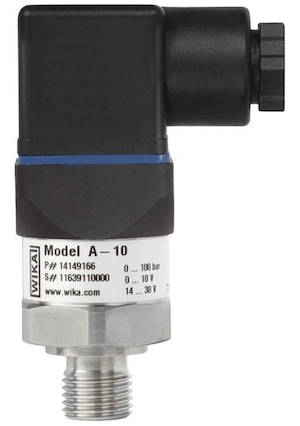
A-10 pressure sensor
Pressure sensors in CDUs measure the pressure in the coolant supply and return lines. Based on the difference between the detected pressures, the control system adjusts the pump speed as necessary. This ensures that optimal pressure and flow are maintained for effective cooling. The machine’s filter conditions can also be monitored by measuring the pressure at the inlets and outlets. In addition, pressure sensors detect anomalies, such as leakage or pressure spikes, and then trigger alarms. This enables operators to take action to prevent equipment or server damage and ensure system efficiency.
The A-10 is a compact yet high-performance sensor for pressure measurement and control in cooling systems. This field-proven sensor is used in industrial applications around the world and can tolerate up to 100 million load cycles with almost constant precision. Integration into any type of CDUs is easy, thanks to the A-10’s convenient configurability and universal applicability.
For standard and high-volume applications, the R-1 offers an excellent price-performance ratio. This robust pressure sensor is expressly designed to monitor and control the condensers, compressors and boosters in heating, ventilation and air-conditioning applications. With stainless steel wetted parts and a hermetically welded thin-film measuring cell, the R-1 is highly resistant to the coolants commonly found in CDUs.
Temperature sensors for coolant distribution units
Temperature sensors ensure that the cooling liquid in CDUs remains within the optimal range for efficient heat transfer. They are also necessary to prevent the condensation that can harm electronic components. Resistance thermometers (RTDs) are usually mounted at the inlet and outlet points, and their measured data is used to regulate the cooling capacity of the system. Ambient temperature is another crucial parameter that has to be monitored in these units.
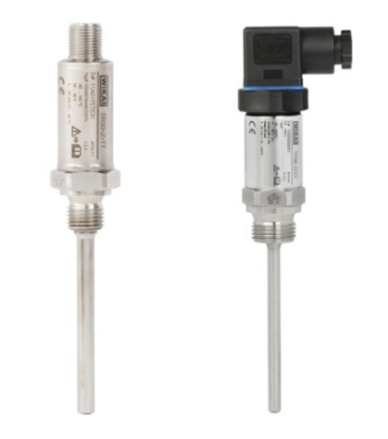
TR33 miniature resistance thermometer (left) and TR36 compact resistance thermometer (right)
The TR33 miniature resistance thermometer and the TR36 resistance thermometer in compact version are ideal for cooling units. These threaded resistance thermometers consist of a thermowell / protection tube with a fixed process connection, and are screwed directly into the process. The Pt100/Pt1000 versions offer direct sensor output, while the versions with integrated transmitters have a 4 … 20 mA output signal. Both offer class A accuracy per IEC 60751.
The TF35 (with plug connection) and the TF37 (with connection lead) are vibration-resistant threaded temperature probes with an integrated thermowell for quick and easy insertion directly into the coolant lines – both in the primary (facility) and secondary (server) circuits. The compact sensors’ measuring range extends from -50 °C (-58 °F) to around +260 °C (+500 °F), and they are available with several measuring elements such as Pt100/Pt1000, NTC or KTY81-210.
For contact temperature monitoring of a coolant distribution unit’s supply and return lines, the TF-2000 is a reliable and cost-effective solution. The Pt100/Pt1000 or NTC measuring element is completely moulded in thermoplastic elastomer (TPE) in accordance with IP68 ingress protection requirements against condensation. Mounting the cable temperature probe to pipes is straightforward. The probe tip can be inserted into a soldered-in copper sleeve and secured with a pipe clamp or a cable tie. Alternatively, the TF-2000, in the version with a brass square sleeve, can be installed at the desired location using a quick-mounting bracket.
Flow sensors for coolant distribution units
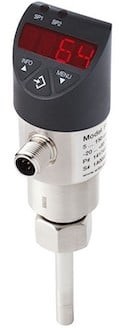
FSD-4 electronic flow switch
Flow sensors monitor coolant circulation to ensure that it flows at an optimal rate for efficient heat transfer. If they detect any deviation from the permissible range, these instruments trigger an adjustment or send out an alarm.
The FSD-4 is expressly designed for the monitoring and control of cooling systems, including the prevention of dry runs in pumps. Thanks to two digital switches, this electronic flow switch can also be programmed for temperature switching. A three-button display makes on-site parameterisation straightforward. Furthermore, a version with IO-Link not only allows remote parameterisation, but also the collection of additional data for condition monitoring, such as operating hours or maximum and minimum values.
Level sensors for coolant distribution units
Level sensors monitor and regulate coolant levels within a reservoir, ensuring that they remain within the defined limits. If the level falls or rises outside of the ideal range, the level sensor triggers an alarm or makes automatic adjustments via switching operations.
The RLT-1000, based on reed chain technology, provides an amplified current or voltage, or a resistance signal via a 3-wire potentiometer. The sensor thus ensures accurate and continuous monitoring of the coolant level inside the tank. The RLS-1000 offers up to four switch points that trigger an alarm when specific level thresholds are reached inside the tank. This robust and reliable sensor is made of stainless steel and features an adaptable guide tube length (150 mm to 1,500 mm), a choice of different floats, and customisable electrical and process connections. This makes it easy to integrate into a variety of system designs.
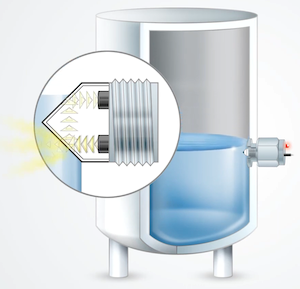
OLS-C04 optoelectronic level switch
The OLS-C04 is an optoelectronic level switch designed specifically for the refrigeration industry, featuring a glass prism fused within its steel case. This compact instrument, mounted on the side of the tank, provides an easy solution for detecting the threshold limit level. It also includes an LED to indicate the switching status.WIKA continually looks for ways to improve our products’ accuracy, durability, functionality, flexibility and cost-effectiveness. This also includes solutions for level measurement. With the CLS-1000 level sensor, we will soon launch a level sensor based on capacitive technology. It will have – among other benefits – the ability to combine multiple functions, including contacts, continuous signalling and temperature measurement.
Conclusion: Smart measurement technology for coolant distribution units
As AI, HPC and liquid cooling applications continue to increase heat densities within modern data centres, reliable measurement technology becomes increasingly critical for efficient and safe CDU operation. You can find further information on the product pages about the pressure, temperature, flow and level measuring instruments mentioned:
- A-10 pressure sensor for general industrial applications
- R-1 pressure sensor for heating and refrigeration
- TR33 threaded miniature resistance thermometer
- TR36 threaded resistance thermometer, compact version
- TF35 threaded temperature probe with plug connection
- TF37 threaded temperature probe with connection lead
- TF-2000 cable temperature probe for heating and refrigeration
- FSD-4 electronic flow switch with display for liquid media
- RLT-1000 reed-chain level sensor for industrial applications
- RLS-1000 float switch for industrial applications
- OLS-C04 optoelectronic level switch for refrigeration technology
- CLS-1000 capacitive level switch for industrial applications
Note
Further information on WIKA’s measurement solutions for data centres is also available on our website. If you have any questions, your contact will gladly help you.
Also read our posts
Pressure measurement: How users benefit from a systems provider
Level limit switches: innovation meets all-rounder
WIKA China: From local production to a recognised competence centre