
The new N-IA TR from WIKA is a passive trap for use in nuclear power plants. Its function is simple. The real challenge lies in meeting nuclear requirements – from material quality and cleanliness through complete documentation and traceability to qualified production and testing processes. To this end, WIKA has set up a complete production line.
The design of the N-IA TR is particularly simplified, featuring a fully welded stainless steel cylinder with several process connections and without moving parts or an active control. Components that are not present cannot fail. This principle makes the trap reliable throughout the entire plant lifetime. Its function is provided solely by the internal geometry. Depending on the version, it collects condensate, separates gases or forms a stable reference column for differential pressure measurement. Thus it is used equally in process, instrumentation and auxiliary systems of nuclear power plants.
A component without moving parts, however, cannot be readjusted. It must meet the specifications starting from the first manufactured part. Therefore, WIKA has set up a complete production line for the N-IA TR that is designed to meet nuclear requirements. After all, while the component itself may be simple, the processes around it are all the more demanding: a quality management system certified per ISO 19443, the highest demands on material quality and cleanliness, complete traceability and documentation. Moreover, all quality-critical and safety-critical manufacturing and testing steps must be carried out by skilled personnel.
Material and proofs in accordance with RCC‑M
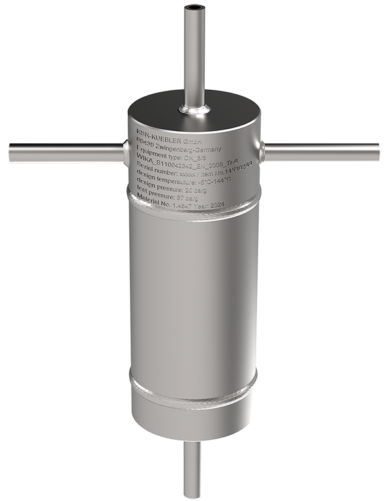
Stainless steel trap, model N-IA TR
In nuclear technology, reliably manufacturing a component is not sufficient. Every material, every weld seam and every test step must be qualified, documented and traceable at all times. With the N-IA TR, WIKA therefore not only supplies the component but also takes on the complete implementation of these requirements.
The N-IA TR is fully welded and manufactured from stainless steel – optionally made from 1.4404 or the seawater‑resistant material 1.4547. Its design is carried out in accordance with the French design code RCC‑M Subsection E, which is the established European standard for small nuclear components. All pressure connections are produced using qualified welding procedures. If desired, WIKA inspects every weld seam 100 percent visually and additionally examines selected seams using dye penetrant testing and X‑ray. If this documentation chain were incomplete at a single point, the component would not meet the requirements of nuclear engineering. This applies regardless of whether it was manufactured flawlessly.
WIKA makes sure to consistently align with the specifics of each project. This already starts with material procurement. The materials are sourced in accordance with customer requirements and documented with a 3.1 inspection certificate per EN 10204, including supplier certificates and chemical analysis. Nothing is used in production that cannot be traced back down to the material batch.
Every nuclear power plant is different
What the end product is in concrete terms is decided by the respective mounting location. Every nuclear power plant is different. Accordingly, the N-IA TR is not an off‑the‑shelf product but is designed on a project‑specific basis. Number, size and arrangement of the process connections – at the top, bottom or side; in DN 8 or DN 25 – depend on the respective mounting location, as do material and internal geometry. This leads to different available variants: condensate traps for steam or hot‑water systems, reference traps for differential pressure measurements as well as degassing and drain traps for the controlled drainage of gases and liquids. While the internal geometry determines the respective function, the external design remains deliberately compact.
An internal volume of less than one litre also facilitates regulatory classification. Together with the ability to qualify up to the highest WIKA Safety Class SC1, the N-IA TR covers the entire spectrum of nuclear requirements – from use in normal operation to safety‑relevant function.
Conclusion: A door opener for worldwide projects in civil nuclear technology
This very consistent qualification creates the prerequisites for use in demanding nuclear projects worldwide. It makes it possible to meet a wide range of national and project‑specific regulatory requirements.
The N-IA TR thus exemplifies WIKA’s role in the field of nuclear power, being not only a component supplier but an engineering partner that takes on the nuclear requirements from project‑specific design through manufacturing to complete proof documentation. Furthermore, due to its flexible design, the N-IA TR is also suitable for retrofit projects. It can be integrated into existing nuclear power plants to meet modern measurement requirements and current safety standards.
Note
Further information on WIKA’s measurement solutions for power generation can be found on our website. Do you have any questions? Please feel free to reach out to your contact person at any time.
Also read our posts
Level measurement in nuclear power plants: Reliability during accidents
WIKA certified in accordance with ISO 19443 for civil nuclear projects
WIKA China: From local production to a recognised competence centre