

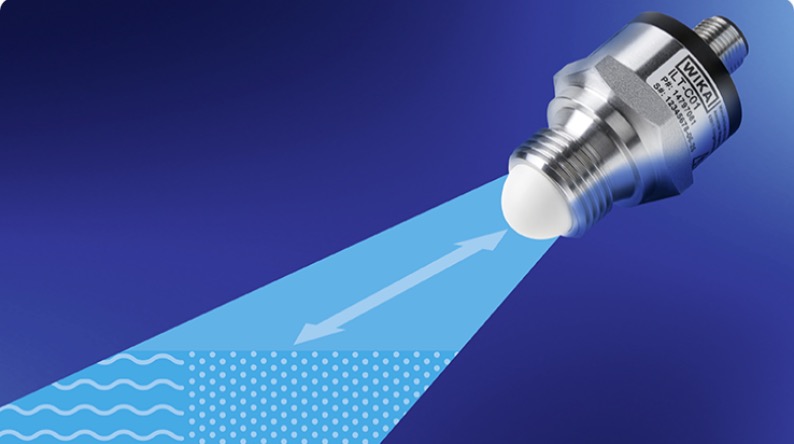
This article is a continuation of “How Non-Contact Radar Level Sensors Solve Tough Industrial Measurement Challenges.”
With its versatility, durability, high accuracy, and ultra-compact size, the ILT series of radar level sensors can be used in a wide array of industrial applications – even under demanding operating conditions.
The pluses and minuses of various level measurement technologies
Float-based level gauges, indicators, and switches work without a power supply and are accurate regardless of foaming, vapors, dust or condensation. But they can be bulky – as tall as the tank’s height – and are not compatible with highly viscous media or heavy-vibration applications.
Optoelectronic level switches have no moving parts, fit in very small tanks, and are suitable for rough operating conditions. Vibrating level switches are similarly robust and compatible with a range of liquids. However, these types of level instruments simply detect a limit level (no level indication), require an opening in the tank wall, and do not transmit data.
Neither float-based level instruments nor optoelectronic and vibrating level switches are equipped to measure powders, grains, etc. Ultrasonic level sensors, which do not come into contact with the media, can determine the level of most liquids and solids. The downside, though, is that varying air characteristics – temperature, pressure, wind, humidity, mist, wind, dust – interfere with the echo signal, resulting in inaccurate, inconsistent level data.
The many benefits of contactless radar level sensing
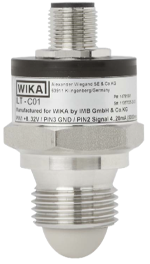
ILT-C01
One type of level sensor (almost) does it all. Non-contact radar level transmitters, like WIKA’s ILT-C01 and ILT-C05, enable reliable level monitoring and switching in numerous industrial applications and under challenging operating conditions. They are free beam as opposed to guided wave, which means there are no probes that need to make contact with the media. Probes also suffer from mechanical stress and material buildup, and require frequent cleaning and maintenance.
Contactless radar level sensing also means that the instrument can be clamped to the outside of certain tanks, as opposed to requiring a hole or opening in the vessel wall for mounting. This is because high-frequency radar signals readily passes through non-conductive, dielectric materials like plastic and fiberglass.
| Contact level measurement | Non-contact | ||||||
| Glass level indicator | Bypass level indicator | Float-based level sensor | Opto-electric level switch | Vibrating | Guided wave radar sensor | Ultrasonic sensor | Free-beam radar sensor |
Does not | ✅ | ✅ | 🆇 | 🆇 | 🆇 | 🆇 | 🆇 | 🆇 |
Compact size | 🆇 | 🆇 | 🆇 | ✅ | ✅ | 🆇 | ✅ | ✅ |
Unaffected by dust, mist, humidity, etc. | ✅ | ✅ | ✅ | ✅ | ✅ | ✅ | 🆇 | ✅ |
Withstands vibration | 🆇 | 🆇 | 🆇 | ✅ | ✅ | 🆇 | ✅ | ✅ |
Has switching ability | 🆇 | ✅ | ✅ | ✅ | ✅ | ✅ | ✅ | ✅ |
Can handle slurries and high-viscosity media | 🆇 | 🆇 | 🆇 | 🆇 | ✅ | ✅ | ✅ | ✅ |
Can measure solids | 🆇 | 🆇 | 🆇 | 🆇 | 🆇 | 🆇 | ✅ | ✅ |
Does not | 🆇 | 🆇 | 🆇 | 🆇 | 🆇 | 🆇 | ✅ | 🆇 |
Table 1: Comparing the merits of various contact and non-contact level measurement technologies
ILT free-beam radar level sensors for practically every industrial application
WIKA specializes in designing and manufacturing industrial measurement instruments that meet our customers’ demand for both top performance and competitive price. This is one reason the company had not offered a wave-based level instrument until the introduction of the ILT series.
The major downside of non-contact radar level sensors had long been its high price tag. Now that the cost of radar sensing components have come down in recent years, these advanced instruments have become a much more affordable level monitoring solution for numerous industrial and general applications, including OEMs. In fact, compared to ultrasonic or traditional radar instruments for the process sector, both the ILT-C01 and ILT C05 are hundreds of dollars cheaper due to their very industrial design.
Users trust the ILT’s data. WIKA’s radar level transmitters are accurate within ±0.2 inches (±5 mm) and have a repeatability of ≤0.079 inches (2 mm), due in large part to 60 GHz frequency modulated continuous waves (FMCW) technology.
Smaller is better
Another major advantage is the ILT’s extremely small footprint. The ILT-C01 is only 1.95 inches (49.5 mm) long. The ILT-C05 is slightly larger, at 2.83″ (72 mm); the extra “standoff” area allows this high-temperature level sensor to increase its tolerance from the standard 212°F (100°C) to 302°F (150°C). With an electrical connection, each radar level sensor is about the size of a pack of gum.
These ultra-compact dimensions make them easy to integrate into almost any application. They are also easy to store, so users can have extras on hand without incurring additional storage costs.
Which industrial applications are non-contact radar level sensors suited for?
Because the ILT free-beam radar sensors are non-invasive, withstand harsh operating conditions, and can measure the level of almost any liquids and solids, they are ideally suited to numerous industries and diverse applications:
- Agriculture – grains/seeds level monitoring in silos
- industrial and off-road vehicles – sprayers (tank level and distance measurement), fire trucks, street sweepers
- Water and wastewater – tanks, lift stations, chemical dosing
- Food, beverage, and pharmaceuticals – bulk solids, powders, liquids
- Chemical and petrochemical – storage vessels
- Power generation and utilities – bulk storage, intermediate tanks
- Granulate preparation – filling height of drying vessels for injection molding
- General industrial and OEMs – skids packaged systems, machine builders
The standard models of the ILT-C01 and ILT-C05 can measure a maximum of 16.4 ft (5 m). Greater measuring heights are available upon request. Note that the ILTs have a 4 inches (10 cm) measuring distance to sealing face. This “dead zone” can be covered by combining the radar sensor with an additional WIKA point-level switch.
The media to be measured should also have a dielectric constant of ≥2 relative permittivity (ε). This category includes most liquids and almost all solids.
WIKA, Smart in Level Sensing
WIKA USA is excited to offer the innovative yet cost-effective ILT industrial level sensors. Contact us for more information about these non-contact radar transmitters, as well as our broad portfolio of level measuring solutions.
Products mentioned in this blog
• ILT-C01 industrial radar level sensor, standard version
• ILT-C05 industrial radar level sensor, high-temperature version