

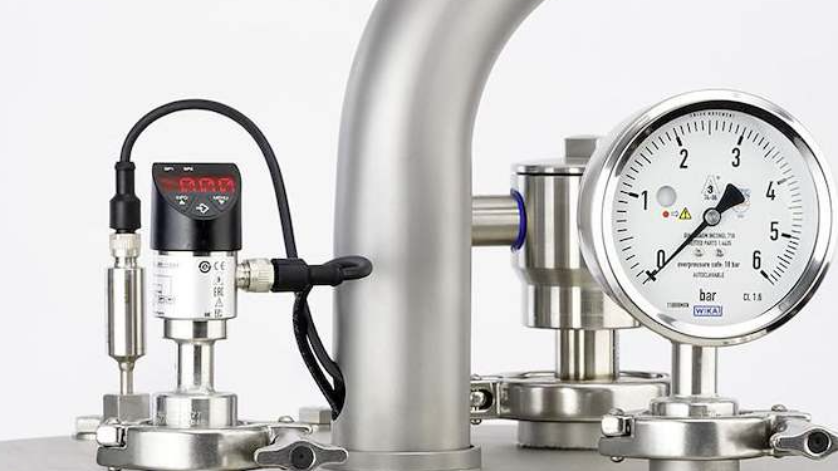
In the food and beverage industry, hygienic design has a direct impact on product safety, cleaning effort and plant availability. Recognised hygiene criteria are particularly important in processes involving frequent product changes, CIP cleaning or stringent auditability and documentation requirements. 3-A hygienic design, based on the requirements of the 3-A Sanitary Standards, provides an important framework in this regard. Even though this guideline originated in the United States, the standards are now used worldwide as a reference for hygienic instrument design.
What characterises 3-A hygienic design?
The 3-A Sanitary Standards, Inc. (3-A SSI) is a non-profit organisation based in the United States. It dates back to the 1920s, when the first hygienic design standards for equipment used in the dairy industry were developed. The name “3-A” historically stands for the cooperation of three interest groups: regulatory authorities, equipment manufacturers and food processors. Today, 3-A SSI describes its mission as “Advancing Food Safety Through Hygienic Design” and positions itself as “The Gold Standard of Hygienic Food Equipment Design”.
The focus is on the detailed 3-A Sanitary Standards and Accepted Practices for equipment, materials, hygienic design and manufacture. These criteria are intended to ensure the cleanability of plants and components in the processing, packaging and handling of dairy products, foodstuffs, pharmaceutical products and other edible products. They include, among other things, requirements for materials, surfaces, radii, connections, seals and design features intended to prevent dead spaces, product deposits and hard-to-clean areas.
The 3-A symbol was introduced for commercial use in 1956 and is a registered mark for equipment that complies with the relevant 3-A Sanitary Standards for design and manufacture. Use of the symbol is voluntary, but it signals to users that the equipment has been designed in accordance with recognised hygienic criteria. Products intended to bear the 3-A symbol require independent Third Party Verification (TPV). This on-site assessment is carried out by a Certified Conformance Evaluator (CCE). Any non-conformities identified must be corrected before authorisation to use the symbol is granted.
For manufacturers and operators, 3-A hygienic design is particularly relevant when very specific design-related requirements must be met. The standards set out precise criteria for hygienically designed components and plants – especially in the United States and in the global food, beverage and pharmaceutical market, where 3-A is established as an internationally recognised framework for hygienic design.
WIKA instrumentation for 3-A-compliant measuring locations
For users, the main benefit of 3-A certification is greater certainty when selecting and standardising hygienic measuring locations. WIKA supports food manufacturers, plant operators and process managers with hygienically designed pressure, temperature, level, force and flow measurement technology as well as calibration technology. The instrumentation helps to reduce microbiological risks, safeguard product quality and integrate measuring locations into plants in a way that enables more efficient CIP and SIP processes.
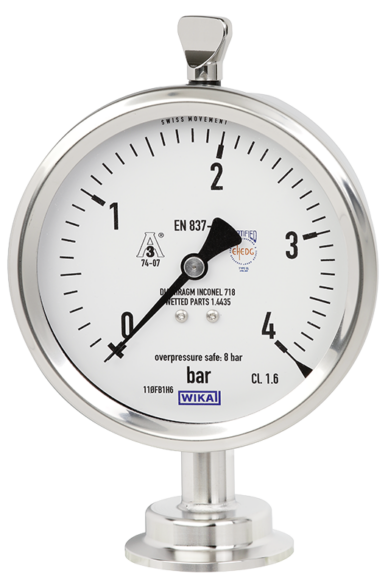
WIKA pressure measuring instrument in hygienic design, 3-A-marked.
A particular advantage lies in the breadth of the certified portfolio. WIKA measuring instruments and diaphragm seal systems are authorised for Standard 74-07 “Sensors and Sensor Fittings and Connections” under 3-A Certificate Authorization Number 646. The listed instruments comprise more than 50 model series and variants – including hygienic diaphragm pressure gauges of the PG43SA series, diaphragm seal systems, in-line diaphragm seals, pressure transmitters, electronic pressure switches, resistance thermometers, in-line resistance thermometers, mechanical thermometers, thermowells / protection tubes and adapter systems.
For food producers and plant operators, this means that measuring locations complying with the requirements of the 3-A standards can be planned, documented and integrated into existing hygiene concepts more easily. With 3-A-marked instruments, authorised manufacturers such as WIKA support standardisation across plants, sites and projects. At the same time, dead-space-free in-line solutions can help to save resources by reducing the cleaning effort, water, energy and cleaning-agent consumption, downtimes and also batch losses.
The specific benefits become clear wherever cleanability, self-draining, residue-free product handling, process safety and auditability are particularly critical – for example in dairies, breweries, aseptic food processes, pharma and biotech plants and CIP/SIP systems.
Conclusion: The added value of 3-A hygienic design for measuring locations
3-A provides operators and plant engineers with a clearly structured proof of hygienic instrument design. In combination with WIKA’s broad 3-A-marked portfolio, this delivers practical added value: hygienic measuring locations can be planned more securely, documented more easily and integrated more efficiently into quality-critical processes.
Independent verification confirms that the instrumentation is designed and manufactured in accordance with the hygienic 3-A Sanitary Standards. This supports compliance with regulatory requirements and uniform conformity assessment. In this way, the standards contribute to ensuring food safety and thus protect consumers.
FAQs on 3-A hygienic design
What does the 3-A symbol mean? The 3-A symbol identifies equipment that complies with the relevant 3-A Sanitary Standards and has been independently verified for conformity.
Why is 3-A relevant for measuring instruments? Measuring instruments with wetted parts for food and beverage production must support hygienic integration, cleanability and auditability. 3-A hygienic design provides a clear basis for assessing their construction and design.
What are the advantages of 3-A-marked measuring instruments? They facilitate standardisation, support cleanability, reduce hygiene risks and improve auditability. In addition, 3-A-marked equipment helps to meet hygiene requirements set out by other standards and authorities. Examples of these include the Pasteurized Milk Ordinance (PMO) and the United States Department of Agriculture (USDA).
Note
Are you interested in hygienic measurement technology? Then visit our website. In addition, further information can be found in our “Sanitary applications” brochure. If you have any questions or concerns, please feel free to contact your WIKA contact at any time.
Also read our posts
EHEDG: Measuring locations with hygienic design
Diaphragm seal system with IO-Link, for the food industry
Pressure switch for safe operation of food silos
New Food: Biomass fermentation harbours complex measuring requirements