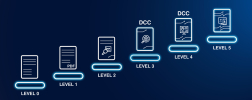
Digitalisation in metrology is not a sudden technological leap, but a development that unfolds in clearly recognisable stages. These stages – the so‑called five digitalisation levels – describe how calibration data develop from their analogue origin towards fully …
Calibration
Digital calibration certificate (DCC): Why a standard secures the future of measurement technology
Matthias BundschuhDigitalisation is changing almost every area of industry – including the calibration of measuring equipment. Where paper documents used to dominate, the digital calibration certificate (DCC for short) is becoming increasingly important. However, as is often the case, …
Why the calibration of (force) measuring instruments is important
Markus HeidlEveryone involved in measurement technology knows the somewhat flippant – but very catchy – statement: “If you measure a lot, you measure nothing!” What is meant by this is: You can measure a lot. But the values are only useful if you can validate them. In …
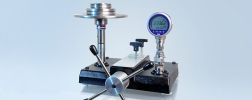
Dual range pistons for pressure calibration
Abhishek SenguptaDual piston deadweight testers can greatly enhance a lab’s ability to calibrate wide pressure ranges with the highest accuracy. With transducers and devices under test (DUTs) that have a wide measuring range, calibration can be a lengthy process, as you must change …
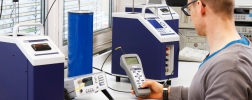
Operation of a temperature dry-well calibrator
Matthias BundschuhDry-well calibrators are portable instruments for the simple on-site calibration of temperature measuring instruments. A temperature dry-well calibrator consists of an electrically heated or cooled metal block, an accurate temperature control and an internal reference …