

3-A and EHEDG are among the world’s most important frameworks for hygienic design in the food and beverage industry. Both are globally recognised and serve the aim of designing process plants and instrumentation to be hygienic, easy to clean and safe. Nevertheless, the two systems differ significantly in terms of origin, certification, evaluation methodology and verification.
3-A relies on clearly defined design requirements and independent third party verification. In contrast, EHEDG takes a more risk-based approach and additionally evaluates the practical cleanability of components. In this blog post, you will learn about the key differences between 3-A and EHEDG and what they mean for hygienic process instrumentation.
Why hygienic design is important for process instrumentation
In sensitive production environments, hygienic design is far more than a question of design-related details. It influences cleanability, product safety, plant availability, resource consumption and the ability to meet quality and audit requirements in a comprehensible manner. Hygienic process instrumentation is particularly relevant where measuring locations are integrated into CIP or SIP processes – in other words, where wetted surfaces must be reliably cleaned and, where necessary, sterilised.
Common goal: Hygienic safety in the process
Both 3-A and EHEDG aim to help users reliably select and use hygienic equipment. The focus is on wetted surfaces, easy-to-clean geometries, suitable materials, hygienic process connections, avoidable dead space and a design that reduces product deposits and microbiological growth.
For operators, this verification is particularly important when measuring locations are part of a quality-critical production process. In such cases, regulatory, customer-specific or audit requirements – both internal and external – must be met
3-A vs. EHEDG: The key differences at a glance
| Criterion | 3-A | EHEDG |
| Origin | USA; historically originated in the dairy industry | Europe; international association of industries, research institutions and authorities |
| Focus | Structural criteria for design, materials and manufacture | Risk-based evaluation of hygienic function and practical cleanability |
| Verification | Third party verification by a Certified Conformance Evaluator | Design review by an EHEDG Authorised Evaluation Officer; depending on the equipment, an additional cleanability test |
| Key strength | Clarity through measurable design requirements | Practical relevance through evaluation of the actual hygienic function |
Collaboration rather than competition
3-A and EHEDG do not consider themselves to be opposites but organisations with comparable goals and complementary strengths. Both promote hygienic design as an important contribution to food safety, product quality and efficient cleaning. Moreover, both EHEDG and 3-A are internationally established references for hygienic equipment design.
Their cooperation drives the international harmonisation of standards, guidelines and best practices. This gives plant constructors, component manufacturers and operators worldwide clearer guidance on how hygienic equipment can be designed, evaluated and integrated into food safety management systems. This cooperation is particularly valuable because both organisations bring different perspectives. 3-A has a strong tradition in specific design criteria, regulatory acceptance and symbol authorisation; EHEDG’s strengths lie in risk-based guidelines, practical evaluation of cleanability and international transfer of knowledge.
The 3-A approach: Design standards and third party verification
Historically, 3-A has strong links to the North American market and the dairy industry. The organisation provides detailed Sanitary Standards and Accepted Practices that define criteria for equipment, materials, hygienic design and manufacture.
The 3-A symbol identifies equipment that complies with the relevant 3-A Sanitary Standards for design and manufacture. In order to be authorised to use this symbol, independent third party verification is required. This is carried out by a Certified Conformance Evaluator, who checks whether the finished equipment complies with the 3-A requirements.
The EHEDG approach: Risk evaluation and cleanability verification
EHEDG has a stronger European influence and takes a practical, risk-based approach. The EHEDG guidelines describe hygienic design principles for plants, production environments and various equipment models.
Guideline 8 “Hygienic Design Principles” forms a key foundation and describes design considerations for preventing product contamination. Certification includes a design evaluation by an EHEDG Authorised Evaluation Officer. If the design evaluation alone is not sufficient, an EHEDG test in accordance with Doc. 2 is required to demonstrate the cleanability of a component in a closed CIP (cleaning in place) system. EHEDG therefore considers not only the design but also practical cleanability.
Putting 3-A and EHEDG into context
For operators of industrial food and beverage processes, the practical benefit does not lie in pitting 3-A and EHEDG against each other. Rather, what matters is which requirements are relevant in terms of the market, application, plant design, customer specifications and audits. 3-A is a suitable choice when clearly measurable design requirements and symbol authorisation are the priorities. In contrast, EHEDG is particularly helpful when the hygienic function and practical cleanability of a component need to be evaluated in the process context.
WIKA instrumentation for 3-A and EHEDG
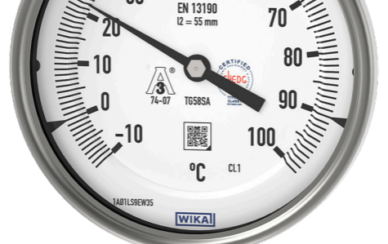
The model TG58SA bimetal thermometer is both 3-A-marked and EHEDG-certified.
WIKA supports hygienic plant concepts with instrumentation for pressure, temperature, level, force, flow and calibration. This enables measuring locations to be integrated into processes that meet both structural design requirements and practical cleanability requirements.
A particular advantage is the breadth of the certified portfolio. For 3-A, more than 50 model series and variants of WIKA measuring instruments and diaphragm seal systems are authorised for Standard 74-07 “Sensors and Sensor Fittings and Connections” under Certificate Authorization Number 646. The EHEDG-certified WIKA portfolio also includes more than 30 model series and versions for pressure and temperature measurement as well as hygienic process adaptations. This allows operators to standardise measuring locations across plants, sites and projects while also covering different market and audit requirements.
When should food manufacturers pay attention to 3-A or EHEDG? Food producers, plant managers and processes managers benefit especially in quality-critical processes. Certified WIKA instrumentation can help reduce microbiological risks, safeguard product quality, make CIP and SIP processes more efficient and support auditability. Dead-space free in-line solutions can also help reduce cleaning effort, water, energy and cleaning-agent consumption, downtime and batch loss.
Conclusion: Together, 3-A and EHEDG offer greater safety for global hygienic design requirements
3-A and EHEDG are not competing but complementary, globally recognised framework systems for hygienic design. Their global collaboration strengthens the international harmonisation of hygienic design principles and promotes a shared understanding of Food Safety by Design. 3-A provides clear, structurally measurable requirements and third party verification. EHEDG enables a risk-based evaluation and – depending on the equipment – practical cleanability tests. With a broad, certified portfolio for both systems, WIKA supports food manufacturers and plant managers in implementing hygienic measuring locations in a process-safe, easy-to-clean, resource-efficient and auditable manner.
FAQs on 3-A and EHEDG
What does 3-A mean? 3-A stands for 3-A Sanitary Standards and defines hygienic requirements for equipment in the food and beverage industry.
What does EHEDG mean? EHEDG stands for European Hygienic Engineering & Design Group. The organisation develops guidelines and certification procedures for hygienic plant design.
What is the difference between 3-A and EHEDG? 3-A focuses on defined design requirements and their independent verification. EHEDG additionally evaluates the hygienic function and, depending on the equipment, the practical cleanability of components and plants.
Can a measuring instrument be both 3-A-marked and EHEDG-certified? Yes. Hygienic measuring instruments and process connections can meet the requirements of both systems and support internationally active operators in standardising their plants.
Note
On our website, you can find out more about WIKA solutions for the food and beverage industry. Our brochures provide information on sanitary applications and pressure displays in hygienic design. Do you have any questions? Please feel free to reach out to your contact person at WIKA at any time.
Also read our posts
EHEDG: Hygienic design with risk-based evaluation and practical cleanability testing
3-A hygienic design: Hygienic measuring locations with clear design criteria
Diaphragm seal system with IO-Link, for the food industry